
Why immersive therapy Is a Powerful New Hope for veterans Living With PTSD
Most therapists who work with veterans know the moment: a session is going well, then the patient startles at a slammed door, scans the room instead of the task, or asks to stop early. Strength and balance have nothing to do with it. For many patients, the reason is post-traumatic stress disorder (PTSD), which changes how the brain reads danger and rarely shows up on the referral.
Veterans sit at the center of this story. Among veterans who use VA health care, about 23 of every 100 have had PTSD at some point in their lives (National Center for PTSD, "Veterans"), and the VA now runs one of the largest clinical VR programs in the country. This post walks through what PTSD does to the brain, how VR-based care helps it relearn safety, what military and VA research actually shows, and what it all means for rehab teams serving veterans. We also look at where augmented reality may fit next, though Smart Therapy™ today delivers VR, eye tracking, and AI documentation rather than AR.
A note on scope: PTSD is diagnosed and treated by licensed mental health professionals. Smart Therapy™ is built for physical, occupational, and neuro rehabilitation, and the best care for trauma survivors connects both teams.
Why PTSD Feels Like a Loop
PTSD involves a cluster of symptoms that tend to feed one another: re-experiencing the trauma, avoiding reminders of it, persistent hyperarousal, negative shifts in mood, sleep problems, and memory difficulties (Iqbal et al.). The VA singles out reliving the event, nightmares, avoiding trauma reminders, and feeling easily startled or constantly on guard as the symptoms most specific to PTSD (National Center for PTSD, "Traumatic Brain Injury").
Avoidance is the piece that keeps the loop turning. When someone steers clear of anything that resembles the traumatic event, whether that is a crowded store, a loud engine, or a certain smell, the brain never gets new evidence that those cues are now safe. Avoidance feels protective in the moment, but it locks the original fear memory in place and often makes the world feel smaller over time.
The circuitry behind the loop
Neuroscientists have mapped much of this pattern onto three brain regions that work together. The leading neurocircuitry model describes the amygdala, the brain's threat detector, as overly responsive in PTSD, while regions of the ventromedial prefrontal cortex (vmPFC) are underactive and fail to calm the amygdala down (Hughes and Shin). The hippocampus, which helps the brain judge context (this place, this time, this level of danger), is the third major region in the model (Hughes and Shin).
A useful way to picture the relationship is a smoke detector, a supervisor, and a map. The amygdala sounds the alarm, the vmPFC decides whether the alarm deserves a response, and the hippocampus supplies the context that tells the supervisor whether the current situation actually resembles the old danger. In PTSD, the alarm is too sensitive and the supervisor is too quiet, so ordinary cues set off a full threat response.
Laboratory studies show how this plays out when people try to unlearn fear. In one functional MRI study comparing people with PTSD to trauma-exposed adults without PTSD, the PTSD group showed greater amygdala activation while learning that a cue was no longer dangerous, then showed less activation in the hippocampus and vmPFC when asked to recall that safety learning the next day (Milad et al.). In plain terms, the brain could take in the lesson during the session but struggled to hold onto it afterward, which is a pattern rehab clinicians may recognize when a patient's confidence seems to reset between visits.
What attention research adds
Eye-tracking studies offer another window into the loop. A systematic review of eye-tracking research found little consistent support for the idea that people with PTSD detect threats faster, but it did find consistent evidence that they keep their gaze on threatening information longer once they find it (Lazarov et al.). The authors suggested that this sustained attention to threat could become a target for future intervention (Lazarov et al.). For clinicians, the takeaway is that PTSD can change where attention goes and how long it stays there, which affects any task that depends on visual focus.
This is one reason eye tracking has become part of how rehab teams think about measurement. Smart Therapy™ supports eye tracking on compatible headsets, giving therapists objective data on visual attention during VR exercises. The platform uses that data for rehabilitation rather than for diagnosing or treating PTSD, but for a veteran whose attention keeps drifting away from the task, seeing that pattern in the data can change how the next exercise is set up.
Researchers continue to refine this picture, and the underlying biology of PTSD is still not fully understood (Iqbal et al.). The model remains useful because it points directly to what treatment needs to accomplish.
How the Brain Learns Safety Again
A common misconception is that exposure therapy erases traumatic memories. The evidence points to something more interesting. Fear extinction is a form of new learning, in which the brain builds a second, competing memory that says this cue no longer predicts danger. The original memory still exists, but the new one learns to win the argument more often.
Animal and human research converge on the idea that the vmPFC dampens amygdala activity during extinction, which makes this prefrontal and amygdala circuit a central target for recovery (Koenigs and Grafman). When people talk about therapy "rewiring the brain," this is the mechanism they mean. Repeated, controlled experiences with trauma reminders, delivered without the original harm, give the prefrontal cortex and hippocampus the practice they need to regulate the amygdala more effectively over time.
The concept will feel familiar to anyone trained in neuro rehabilitation. Motor recovery after stroke depends on repetition, gradual progression, and enough challenge to drive change without overwhelming the patient. Extinction learning follows similar rules, with the difference that the system being retrained is the brain's threat response rather than a movement pattern.
Evidence that the change is visible
Some of the clearest evidence comes from military research. A team working with service members who had PTSD after deployment to Iraq or Afghanistan used functional MRI to scan participants before and after exposure therapy and reported that activation in the amygdala, prefrontal cortex, and anterior cingulate gyrus moved toward normal after treatment (Roy et al., "Compelling Evidence"). Because a group of combat-exposed controls showed no significant change on repeat scans over the same intervals, the authors concluded that the shift reflected a treatment effect rather than a practice effect from being scanned more than once (Roy et al., "Compelling Evidence").
An earlier report from the same research program randomized service members with PTSD to either VR exposure or imaginal exposure and found that clinician ratings and fMRI scans showed significant improvement in both arms, although gains on the Clinician-Administered PTSD Scale were more modest (Roy et al., "Improvement in Cerebral Function"). Taken together, these studies support a careful but encouraging conclusion: when exposure-based treatment works, the change is not only reported by patients but can also be observed in the circuits that drive the fear response.
Why Veterans Sit at the Center of This Story
PTSD is somewhat more common among veterans than civilians. The National Center for PTSD estimates that 7 of every 100 veterans will have PTSD at some point in their lives, compared with 6 of every 100 adults in the general population, and the rate among female veterans (13 of every 100) is roughly double the rate among male veterans (6 of every 100) (National Center for PTSD, "Veterans").
The picture changes considerably by service era. The VA's most recent national estimates, drawn from a large study of living veterans, show the following:
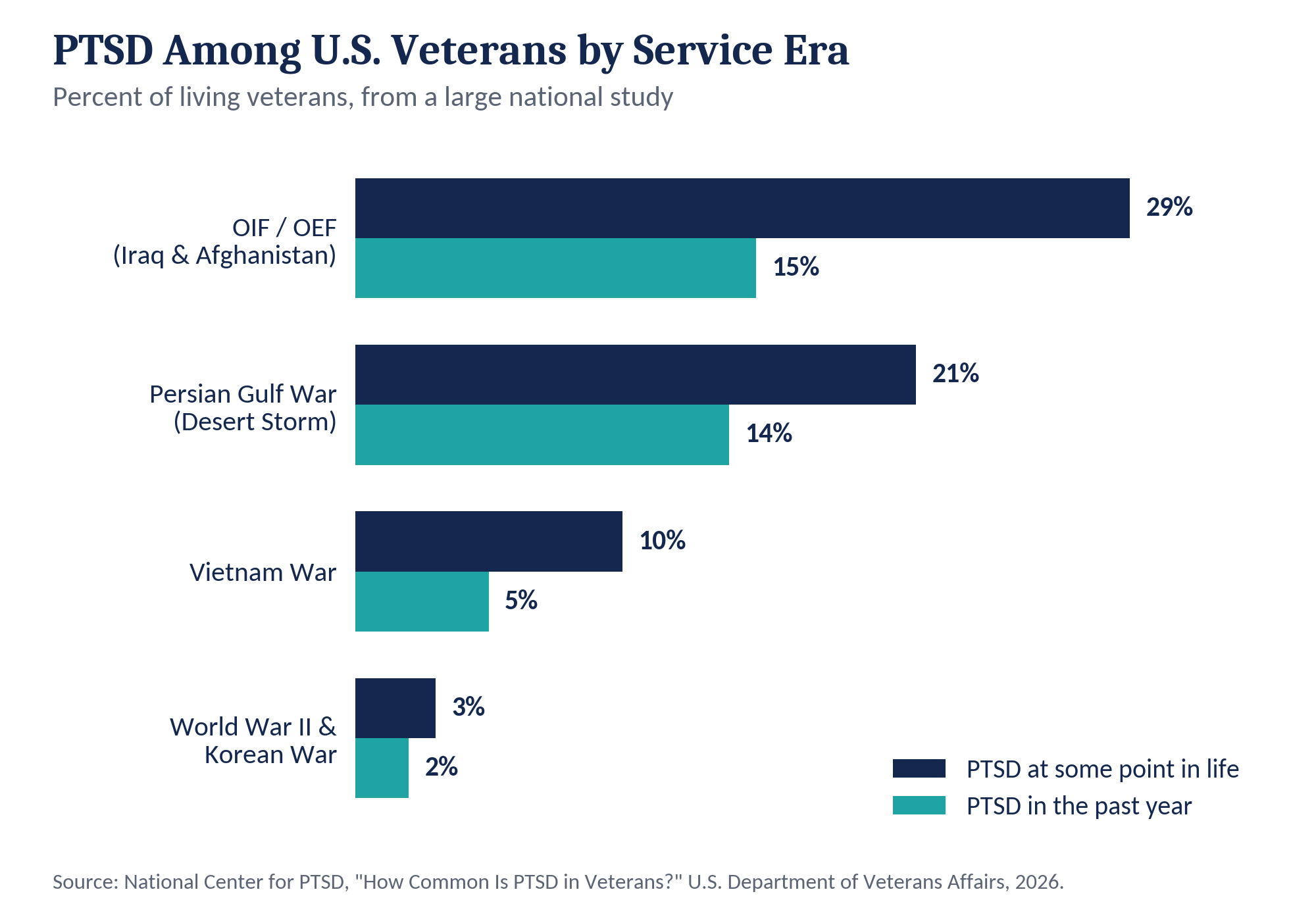
The VA notes that these figures come only from veterans alive at the time of the study, and that older research suggested higher rates among Vietnam veterans in particular (National Center for PTSD, "Veterans"). Deployment itself matters as well, with some studies finding PTSD about three times more likely among veterans who deployed than among those of the same era who did not (National Center for PTSD, "Veterans").
The VA caseload in particular
The numbers are highest among veterans who actually receive care through the VA, which is the population VA rehabilitation teams see every day. Of the 5.8 million veterans the VA served in fiscal year 2024, about 14 of every 100 men and 24 of every 100 women carried a PTSD diagnosis (National Center for PTSD, "Veterans"). Part of the gap between VA users and other veterans likely reflects the fact that the VA screens every veteran patient for PTSD and military sexual trauma (MST), which surfaces cases that might go unrecognized elsewhere (National Center for PTSD, "Veterans").
MST deserves specific attention because it reshapes what trauma-informed care looks like in a rehab setting. When screened by their VA provider, about 1 in 3 women veterans and about 1 in 50 men report experiencing MST, and PTSD is one of the most common mental health diagnoses associated with it (National Center for PTSD, "Veterans"). For a physical or occupational therapist, that history can make hands-on cueing, close physical proximity, or a loss of visual awareness inside a headset feel very different to the patient than it looks to the clinician.
The practical conclusion is simple. In VA rehabilitation, PTSD is not an occasional complication to plan around once in a while. It is a routine part of the caseload, often present alongside the very conditions that brought the veteran to rehab in the first place.
PTSD Rarely Travels Alone: TBI, Pain, and the Polytrauma Clinical Triad
For rehab teams, the most important thing to understand about military PTSD may be how often it arrives bundled with other conditions. The same events that cause traumatic brain injury, such as blasts, vehicle crashes, assaults, and falls, can also be psychologically traumatic, so many veterans carry both a physical injury to the brain and the psychological aftermath of how it happened (National Center for PTSD, "Traumatic Brain Injury").
Researchers working with veterans of the wars in Iraq and Afghanistan gave this pattern a name. In a 2009 study of OEF/OIF veterans with a history of TBI, about 42 percent were diagnosed with the full combination of chronic pain, PTSD, and persistent post-concussive symptoms, while only 10.3 percent had chronic pain alone, 2.9 percent had PTSD alone, and 5.3 percent had post-concussive symptoms alone (Lew et al.). That cluster became known as the polytrauma clinical triad. A later analysis of the broader population of post-9/11 veterans in VA care found that 40.2 percent carried a pain diagnosis, 29.3 percent a PTSD diagnosis, and 9.6 percent a TBI diagnosis, with 6 percent carrying all three (Cifu et al.).
When symptoms overlap
The overlap matters clinically because PTSD and TBI share several symptoms that a rehab clinician might otherwise attribute to only one cause. According to the VA, both conditions can involve sleep problems, negative thoughts and feelings, irritability and anxiety, memory problems, and trouble concentrating (National Center for PTSD, "Traumatic Brain Injury"). Headaches, dizziness, nausea, vision problems, and sensitivity to light or noise are more specific to TBI, while reliving the event, nightmares, avoidance of reminders, and being easily startled are more specific to PTSD (National Center for PTSD, "Traumatic Brain Injury").
Consider what that means during vestibular or visual rehabilitation. A veteran who stops mid-task could be dizzy, could be overwhelmed by visual motion, or could be reacting to something in the environment that resembles a past threat. Each explanation calls for a different response, and the VA itself notes that TBI-related symptoms and PTSD symptoms together can reduce a person's ability to recover on their own (National Center for PTSD, "Traumatic Brain Injury").
There is encouraging news here as well. The VA reports that the most effective PTSD treatments, including cognitive processing therapy and prolonged exposure, appear to work as well for people with a history of TBI as for those without one, and that early evidence suggests completing these treatments may also improve TBI-related symptoms (National Center for PTSD, "Traumatic Brain Injury"). The VA built its Polytrauma System of Care around this reality, routing veterans with the most severe injuries to Polytrauma Rehabilitation Centers and Network Sites while local medical centers support others, with a stated goal of "no wrong door" for treatment (National Center for PTSD, "Traumatic Brain Injury").
Beyond the military
The same overlap appears in civilian rehab. In the TRACK-TBI study of patients seen in emergency departments for mild TBI, injuries caused by assault or other violence were associated with a higher risk of probable PTSD at six months (Stein et al.). After stroke, about 23 percent of survivors experience PTSD symptoms within the first year, and about 11 percent still do more than a year later (Edmondson et al.). For older veterans in particular, a stroke or serious fall can stack a new medical trauma on top of an old one, which is worth keeping in mind for any clinician working in VA inpatient or outpatient rehab.
Where Gold-Standard Therapy Falls Short
The VA and the Department of Defense have a clear first-line answer for PTSD. The 2023 VA/DoD Clinical Practice Guideline recommends specific manualized psychotherapies over medication, naming prolonged exposure, cognitive processing therapy, and eye movement desensitization and reprocessing (EMDR) as recommended options (Schnurr et al.). These treatments help many veterans, and nothing about VR changes that.
The harder truth is that even the best-supported therapies leave a lot of veterans still struggling. A review of randomized trials in military and veteran populations published in JAMA found that cognitive processing therapy and prolonged exposure produced clinically meaningful improvement for many patients, yet average post-treatment scores stayed at or above the clinical threshold for PTSD, and roughly two-thirds of patients (range, 60 to 72 percent) still met criteria for PTSD after treatment (Steenkamp et al.). The authors called for improving existing treatments and developing and testing new ones (Steenkamp et al.).
Part of the challenge is engagement. Traditional prolonged exposure relies heavily on imaginal exposure, in which the patient recalls the traumatic memory in detail and describes it aloud. Greg Reger, a psychologist who led one of the major military VR trials, observed that imaginal exposure may work less well for combat trauma because repeated exposure to stress during deployment can leave service members emotionally disengaged, which makes it harder to access the memory with the intensity that treatment requires ("Virtual Reality Exposure Therapy to Combat PTSD"). Avoidance, the core symptom, can also make patients reluctant to start or continue a treatment built around confronting the very memories they have spent years avoiding.
That combination, a strong evidence base with real gaps in reach and response, is what pushed military and VA researchers toward virtual reality. The goal was never to replace exposure therapy. It was to find a way to deliver it that more veterans could engage with and complete.
How VR Entered Military Trauma Care
Much of what the field knows about VR for PTSD comes from work with service members and veterans. Three lines of research stand out for anyone trying to understand where the evidence came from and where it is heading.
-
The best-known system is Bravemind, a VR exposure therapy platform developed at the University of Southern California Institute for Creative Technologies. In Bravemind, a trained therapist guides the patient through virtual scenarios built to resemble relevant contexts, so the patient can confront and reprocess trauma memories under safe and controlled conditions (USC Institute for Creative Technologies). According to the institute, Bravemind has been distributed to more than 170 clinical sites over its history, and a partnership with the SoldierStrong Foundation provides the equipment and clinical training at no cost to VA medical centers and other sites serving veterans (USC Institute for Creative Technologies). Later versions were adapted for patients with PTSD related to military sexual trauma, and the institute reports that 76 percent of incoming patients in one trial preferred VR exposure over traditional therapy (USC Institute for Creative Technologies).
That preference finding deserves attention even though it is not an outcome measure. In a population where avoidance and stigma both keep people out of treatment, a format veterans are willing to try has practical value on its own.
-
The most rigorous head-to-head test in a military population came from a randomized trial led by Greg Reger and published in 2016. The study randomized 162 active-duty soldiers with PTSD from deployments to Iraq and Afghanistan to 10 sessions of standard prolonged exposure, 10 sessions of VR exposure, or a minimal-attention waitlist, with blinded assessors evaluating symptoms through six months of follow-up (Reger et al.).
Both active treatments significantly reduced PTSD symptoms compared with the waitlist, and dropout before completing all 10 sessions was similar in both groups (44 percent for VR exposure and 41 percent for prolonged exposure) (Reger et al.). VR exposure was not superior to prolonged exposure at the end of treatment, and follow-up analyses found that prolonged exposure produced significantly greater symptom reductions at three and six months (Reger et al.). The authors concluded that prolonged exposure is an efficacious treatment for active-duty soldiers and that the results raised important questions for future research on VR exposure (Reger et al.). -
A newer approach may be the most interesting for rehabilitation professionals. Multimodular motion-assisted memory desensitization and reconsolidation, or 3MDR, combines exposure therapy, psychotherapy, elements drawn from EMDR, virtual reality, supportive counseling, and walking on a treadmill, and it is being studied with military members and veterans in the Netherlands, the United States, the United Kingdom, and Canada (Jones et al.). The intervention was designed with treatment-resistant PTSD in mind, a label used for the many veterans who do not see clinically significant improvement after evidence-based treatment (Jones et al.).
In a randomized controlled trial with 42 British male veterans who had treatment-resistant, service-related PTSD, the group that received 3MDR immediately scored about 9.4 points lower on the Clinician-Administered PTSD Scale at 12 weeks than the group waiting for treatment, with an estimated effect size of 0.65 (Bisson et al.). Improvements held at the 26-week follow-up, and the authors found 3MDR acceptable to most, though not all, participants (Bisson et al.). It is an exploratory trial rather than a final answer, but the idea of pairing trauma processing with walking and forward motion is a natural point of curiosity for anyone who works in gait and mobility.
What veterans are asking for
One of the most useful observations for rehab clinicians came from Dr. Anne Lord Bailey, who leads VA Immersive. Speaking with veteran service organizations, she explained that what veterans often ask for is in vivo exposure, meaning the chance to practice everyday environments that may be triggering or anxiety-provoking for any number of reasons ("VA Using Virtual Reality"). She also described a veteran whose grip strength began improving after regular use of hand controllers during VR activities like virtual fishing ("VA Using Virtual Reality").
Those two details capture why VR sits so comfortably between mental health and rehabilitation in the VA. A grocery store aisle, a busy parking lot, or a crowded waiting room can be a balance challenge, a cognitive load challenge, and a trauma reminder all at once. When the same headset can support motor practice and graded exposure to real-world complexity, the line between "rehab task" and "trauma-informed practice" gets thinner, and the need for coordination between disciplines gets stronger.
Smart Therapy™ is part of this picture as well, with VA rehabilitation teams among the clinics using the platform for VR-based physical, occupational, and neuro therapy. In those settings, the clinical value comes from the therapist's control over the experience rather than from the headset alone.
What the Evidence Actually Says
VR is promising for PTSD, but the research supports a measured message rather than a miracle claim. Clinicians, and the veterans they serve, deserve the full picture.
-
Researchers suggest that immersive exposure may strengthen treatment by increasing a patient's sense of presence, meaning the experience feels real enough to engage the fear response while staying fully under clinical control (Eshuis et al.). VR also solves a practical problem, since recreating real-world triggers in person can be impractical or unsafe (Eshuis et al.).
Several meta-analyses support VR's effectiveness. A 2019 analysis of nine controlled studies with 296 participants found that VR exposure significantly outperformed waitlist controls for PTSD and depressive symptoms, with no significant difference between VR exposure and active treatments (Kothgassner et al.). A separate meta-analysis published the same year reported a moderate overall effect of VR exposure compared with control conditions (Deng et al.). A 2022 meta-analysis found that VR-based graded exposure, in which intensity increases step by step, produced a large effect on PTSD symptoms compared with controls (Hedges' g = 1.10), while conventional VR exposure showed no significant difference from controls in the same analysis (Heo and Park). That last finding suggests that how the exposure is graded and tailored may matter more than the headset itself.
-
These findings do not contradict each other as much as they first appear to. VR exposure reliably beats doing nothing, appears roughly comparable to other active treatments in pooled analyses, and does not outperform well-delivered standard prolonged exposure in the head-to-head military trials the VA reviewed. The reasonable conclusion is that VR is a delivery tool rather than a shortcut. The active ingredients are the exposure principles themselves and the skill of the clinician guiding them, and VR's value lies in how precisely it lets that clinician control, grade, and repeat the experience for patients who might not engage otherwise.
What This Means for Rehab Teams Serving Veterans
Most physical and occupational therapists will never deliver trauma-focused psychotherapy, and they should not try to. What they can do is make sure the rehab session itself supports recovery instead of working against it. That is the core idea behind a trauma-informed approach.
The Substance Abuse and Mental Health Services Administration (SAMHSA) describes six principles of a trauma-informed approach: safety; trustworthiness and transparency; peer support; collaboration and mutuality; empowerment, voice, and choice; and attention to cultural, historical, and gender issues (SAMHSA). A trauma-informed approach is different from trauma-specific therapy, because its aim is to deliver every service in a way that avoids retraumatizing the people who receive it (SAMHSA). Here is how those principles translate to VR-based rehab with veterans.
-
Given the overlap between PTSD and TBI symptoms, the first skill is curiosity rather than assumption. A veteran who freezes, scans the environment, or suddenly wants to stop may be dizzy, cognitively overloaded, in pain, or responding to a trauma reminder, and the right response depends on which one it is. Asking a simple, nonjudgmental question, such as what the patient noticed just before they wanted to stop, often tells you more than any outcome measure in the moment.
-
Putting on a VR headset removes a patient's view of the real room, which can feel very different for someone who has learned to keep their back to the wall and their eyes on the door. Explaining exactly what the patient will see and hear before the session starts reflects SAMHSA's emphasis on transparency. Agreeing on a clear stop signal gives the patient real voice and choice, and telling them where you will be standing in the room removes one more unknown. For veterans with a history of military sexual trauma, asking before any hands-on cueing, and offering verbal cues first, is a small adjustment that can matter a great deal.
-
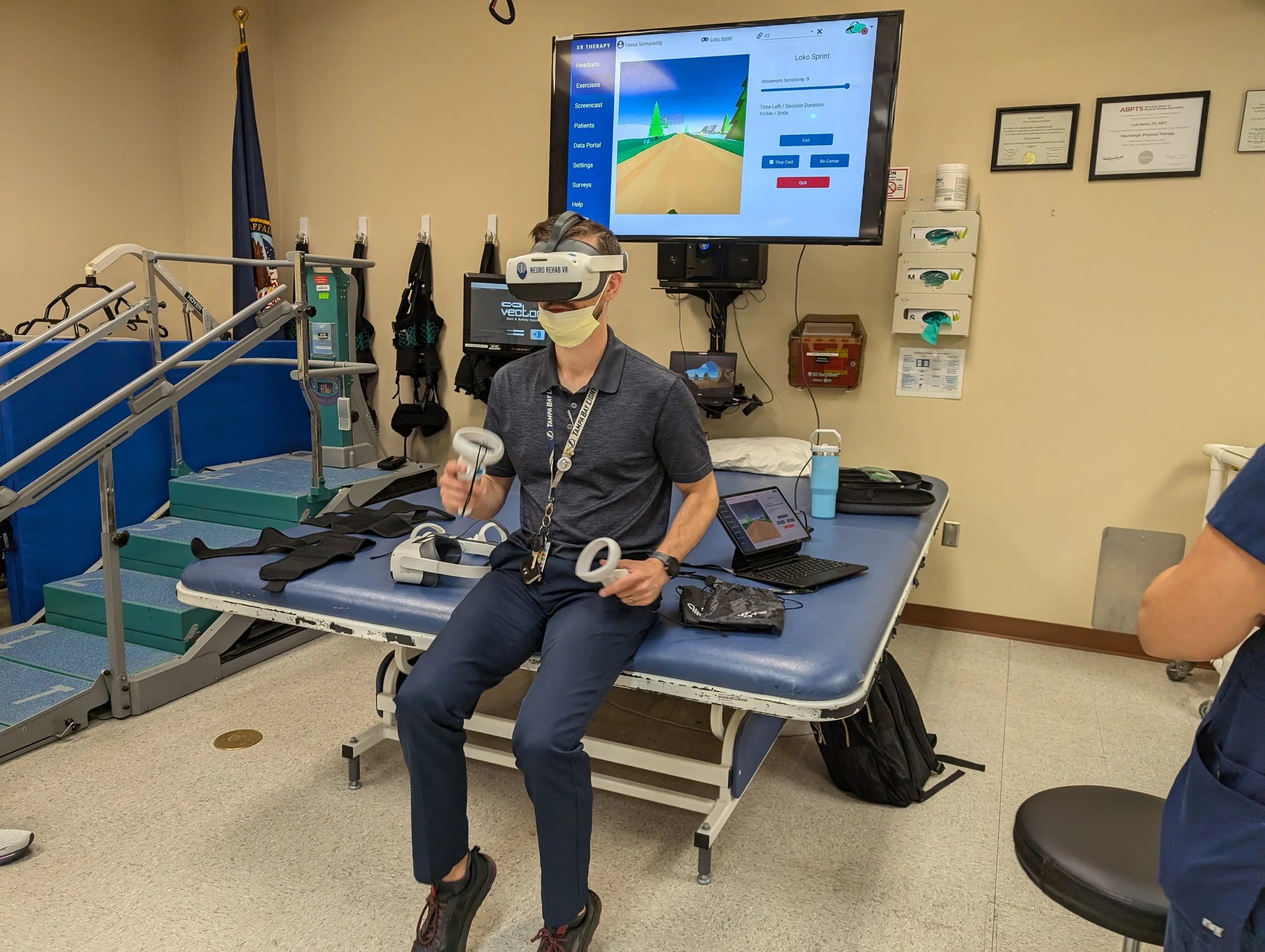
The exposure literature offers a useful model for progression even when the goal is motor or functional rather than psychological. Start with predictable, low-demand environments, increase sensory and cognitive complexity in small, deliberate steps, and let confidence lead before difficulty increases. The graded VR findings discussed above (Heo and Park) and the VA's emphasis on practicing everyday environments ("VA Using Virtual Reality") both point in the same direction. In Smart Therapy™, the therapist controls the experience from a tablet and sees what the patient sees, which makes it easier to connect a change in posture, breathing, or engagement to something specific in the environment and to scale it back right away.
-
Rehab clinicians are often the ones who see how trauma shows up in movement, balance, and daily function, and that information is valuable to the rest of the care team. Clear notes on what settings a patient tolerated, what seemed to trigger distress, and how tolerance changed over time give mental health providers and physicians a functional view they may not get anywhere else. When trauma-related needs go beyond rehab's scope, a warm referral, ideally within the same polytrauma or interdisciplinary team, keeps the veteran inside the "no wrong door" model the VA describes (National Center for PTSD, "Traumatic Brain Injury").
None of this asks rehab teams to become trauma therapists. It asks them to recognize that the conditions they treat and the trauma their patients carry are often tangled together, and to run sessions in a way that respects both.
Looking Ahead: Where Augmented Reality May Fit
Virtual reality replaces a person's surroundings. Augmented reality overlays digital content onto the real world instead, and that difference could matter a great deal for trauma-informed care. Researchers have proposed that AR exposure could strengthen presence much as VR does, yet a 2021 systematic review found no clinical trials testing AR exposure therapy for PTSD and identified it as a research gap with potential (Eshuis et al.).
For rehabilitation, AR raises an intriguing possibility on the longer horizon: practicing confidence and regulation inside the patient's real environment, such as their own kitchen, a familiar street, or the hallway outside the clinic, where the goals of recovery ultimately live. For a veteran who avoids crowded places, that could someday mean graded practice that never asks them to give up their view of the room.
Smart Therapy™ today delivers VR, eye tracking, and AI documentation, and augmented reality is part of our plans for the future. As that work takes shape alongside the research, the same principles covered throughout this post, including therapist control, gradual progression, and patient choice, will guide how we bring AR into rehabilitation for veterans and every patient we serve.
Breaking the Cycle
PTSD persists because avoidance keeps the brain from learning that the danger has passed. Effective treatment breaks that cycle by offering controlled, repeated, gradually intensifying experiences that help the prefrontal cortex and hippocampus regain influence over the amygdala, and imaging research with service members suggests those changes can be observed in the brain itself (Roy et al., "Compelling Evidence").
Veterans have been at the center of this science from the start, through VA and military trials, and through VA immersive programs that now reaches more than 170 medical centers (“VA Using Virtual Reality”). VR gives clinicians unusual precision in shaping difficult experiences, and many veterans are more willing to engage with it.
For rehabilitation teams, the opportunity is to bring that same precision and trauma-informed intent to every session. Veterans who carry trauma into the clinic deserve care that respects both the injury on their chart and the experience behind it, so they can keep making progress on the physical and functional goals that brought them there. As immersive technology continues to evolve, including the AR research now taking shape, the clinicians who understand both the science and the person in front of them will be best positioned to use it well.
To see how Smart Therapy™ supports VR-based physical, occupational, and neuro rehabilitation, visit the Smart Therapy™ Complete Solution page.
If you are a veteran in crisis, or you are worried about one, the Veterans Crisis Line is available by dialing 988 and pressing 1, or by texting 838255. Anyone in the United States can also call or text 988 to reach the 988 Suicide & Crisis Lifeline.
-
American Legion. “VA Using Virtual Reality to Advance Care.” The American Legion, 2025, www.legion.org/information-center/news/veterans-healthcare/2025/december/va-using-virtual-reality-to-advance-care. Accessed 21 Oct. 2026.
Bisson, J. I., et al. “Randomized Controlled Trial of Multi‐Modular Motion‐Assisted Memory Desensitization and Reconsolidation (3MDR) for Male Military Veterans With Treatment‐Resistant Post‐Traumatic Stress Disorder.” Acta Psychiatrica Scandinavica, vol. 142, no. 2, 28 June 2020, pp. 141–151, 10.1111/acps.13200.
Cifu, David X., et al. “Traumatic Brain Injury, Posttraumatic Stress Disorder, and Pain Diagnoses in OIF/OEF/OND Veterans.” Journal of Rehabilitation Research and Development, vol. 50, no. 9, 2013, pp. 1169–1176, 10.1682/jrrd.2013.01.0006.
Deng, Wenrui, et al. “The Efficacy of Virtual Reality Exposure Therapy for PTSD Symptoms: A Systematic Review and Meta-Analysis.” Journal of Affective Disorders, vol. 257, 1 Oct. 2019, pp. 698–709, www.sciencedirect.com/science/article/pii/S0165032719308328, 10.1016/j.jad.2019.07.086. Accessed 20 Oct. 2026.
Edmondson, Donald, et al. “Prevalence of PTSD in Survivors of Stroke and Transient Ischemic Attack: A Meta-Analytic Review.” PLoS ONE, vol. 8, no. 6, 19 June 2013, p. e66435, 10.1371/journal.pone.0066435.
Eshuis, L.V., et al. “Efficacy of Immersive PTSD Treatments: A Systematic Review of Virtual and Augmented Reality Exposure Therapy and a Meta-Analysis of Virtual Reality Exposure Therapy.” Journal of Psychiatric Research, vol. 143, Nov. 2021, pp. 516–527, 10.1016/j.jpsychires.2020.11.030.
Graham, Edward . “VA Expands Use of Extended Reality Tech Across Healthcare Operations - Nextgov/FCW.” Nextgov.Com, 2026, www.nextgov.com/emerging-tech/2026/07/va-expands-use-extended-reality-tech-across-healthcare-operations/414913/. Accessed 20 Oct. 2026.
Heo, Seoyoon, and Jin-Hyuck Park. “Effects of Virtual Reality-Based Graded Exposure Therapy on PTSD Symptoms: A Systematic Review and Meta-Analysis.” International Journal of Environmental Research and Public Health, vol. 19, no. 23, 29 Nov. 2022, p. 15911, 10.3390/ijerph192315911.
Hughes, Katherine C, and Lisa M Shin, 21306214. “Functional Neuroimaging Studies of Post-Traumatic Stress Disorder.” Expert Review of Neurotherapeutics, vol. 11, no. 2, Feb. 2011, pp. 275–85. PubMed Central, pubmed.ncbi.nlm.nih.gov/21306214/, 10.1586/ern.10.198. Accessed 20 Oct. 2026.
Iqbal, Javed, et al. “The Neural Circuits and Molecular Mechanisms Underlying Fear Dysregulation in Posttraumatic Stress Disorder.” Frontiers in Neuroscience, vol. 17, 5 Dec. 2023, 10.3389/fnins.2023.1281401.
Jones, Chelsea, et al. “Virtual Reality–Based Treatment for Military Members and Veterans With Combat-Related Posttraumatic Stress Disorder: Protocol for a Multimodular Motion-Assisted Memory Desensitization and Reconsolidation Randomized Controlled Trial.” JMIR Research Protocols, vol. 9, no. 10, 29 Oct. 2020, p. e20620, 10.2196/20620.
Koenigs, Michael, and Jordan Grafman. “Posttraumatic Stress Disorder: The Role of Medial Prefrontal Cortex and Amygdala.” The Neuroscientist, vol. 15, no. 5, 9 Apr. 2009, pp. 540–548, 10.1177/1073858409333072.
Kothgassner, Oswald D., et al. “Virtual Reality Exposure Therapy for Posttraumatic Stress Disorder (PTSD): A Meta-Analysis.” European Journal of Psychotraumatology, vol. 10, no. 1, 19 Aug. 2019, www.ncbi.nlm.nih.gov/pmc/articles/PMC6713125/, 10.1080/20008198.2019.1654782. Accessed 20 Oct. 2026.
Lazarov, Amit, et al. “Attention to Threat in Posttraumatic Stress Disorder as Indexed by Eye-Tracking Indices: A Systematic Review.” Psychological Medicine, vol. 49, no. 5, 1 Apr. 2019, pp. 705–726, pubmed.ncbi.nlm.nih.gov/30178728/, 10.1017/S0033291718002313. Accessed 20 Oct. 2026.
Lew, Henry L., et al. “Prevalence of Chronic Pain, Posttraumatic Stress Disorder, and Persistent Postconcussive Symptoms in OIF/OEF Veterans: Polytrauma Clinical Triad.” The Journal of Rehabilitation Research and Development, vol. 46, no. 6, 2009, p. 697, 10.1682/jrrd.2009.01.0006.
Milad, Mohammed R., et al. “Neurobiological Basis of Failure to Recall Extinction Memory in Posttraumatic Stress Disorder.” Biological Psychiatry, vol. 66, no. 12, Dec. 2009, pp. 1075–1082, www.biologicalpsychiatryjournal.com/article/S0006-3223(09)00896-8/abstract, 10.1016/j.biopsych.2009.06.026. Accessed 20 Oct. 2026.
National Center for PTSD. “How Common Is PTSD in Adults?” U.S. Department of Veteran Affairs, 26 Mar. 2025, www.ptsd.va.gov/understand/common/common_adults.asp. Accessed 20 Oct. 2026.
Reger, Greg M., et al. “Randomized Controlled Trial of Prolonged Exposure Using Imaginal Exposure Vs. Virtual Reality Exposure in Active Duty Soldiers With Deployment-Related Posttraumatic Stress Disorder (PTSD)..” Journal of Consulting and Clinical Psychology, vol. 84, no. 11, Nov. 2016, pp. 946–959, 10.1037/ccp0000134.
Rizzo, Albert "Skip" . “Bravemind: Virtual Reality Exposure Therapy - Institute for Creative Technologies.” Ict.Usc.Edu, 27 Aug. 2021, ict.usc.edu/research/projects/bravemind-virtual-reality-exposure-therapy/. Accessed 20 Oct. 2026.
Roy, Michael J, et al., 24875691. “Compelling Evidence That Exposure Therapy for PTSD Normalizes Brain Function.” Studies in Health Technology and Informatics, vol. 199, 2014, pp. 61–5. PubMed, pubmed.ncbi.nlm.nih.gov/24875691/. Accessed 20 Oct. 2026.
Roy, Michael J., et al. “Improvement in Cerebral Function With Treatment of Posttraumatic Stress Disordera.” Annals of the New York Academy of Sciences, vol. 1208, no. 1, Oct. 2010, pp. 142–149, 10.1111/j.1749-6632.2010.05689.x.
SAMHSA’s Trauma and Justice Strategic Initiative. SAMHSA’s Concept of Trauma and Guidance for a Trauma-Informed Approach Prepared by SAMHSA’s Trauma and Justice Strategic Initiative. 2014.
Schnurr, Paula P., et al. “The Management of Posttraumatic Stress Disorder and Acute Stress Disorder: Synopsis of the 2023 U.S. Department of Veterans Affairs and U.S. Department of Defense Clinical Practice Guideline.” Annals of Internal Medicine, vol. 177, no. 3, 27 Feb. 2024, www.healthquality.va.gov/guidelines/MH/ptsd/PTSD-in-Annals-2024.pdf, 10.7326/m23-2757. Accessed 20 Oct. 2026.
Smith, Lorin . “Virtual Reality Exposure Therapy to Combat PTSD.” Www.Army.Mil, www.army.mil/article/33128/virtual_reality_exposure_therapy_to_combat_ptsd. Accessed 21 Oct. 2026.
Steenkamp, Maria M., et al. “Psychotherapy for Military-Related PTSD.” JAMA, vol. 314, no. 5, 4 Aug. 2015, p. 489, doi.org/10.1001/jama.2015.8370, 10.1001/jama.2015.8370. Accessed 20 Oct. 2026.
Stein, Murray B, et al. “Risk of Posttraumatic Stress Disorder and Major Depression in Civilian Patients After Mild Traumatic Brain Injury: A TRACK-TBI Study.” JAMA Psychiatry, vol. 76, no. 3, 2019, pp. 249–258, www.ncbi.nlm.nih.gov/pubmed/30698636, 10.1001/jamapsychiatry.2018.4288. Accessed 20 Oct. 2026.
National Center for PTSD. “Traumatic Brain Injury and PTSD.” U.S. Department of Veterans Affairs, www.ptsd.va.gov/understand/related/tbi_ptsd.asp. Accessed 21 Oct. 2026.