How To Empower Patients To Overcome Real-World Challenges
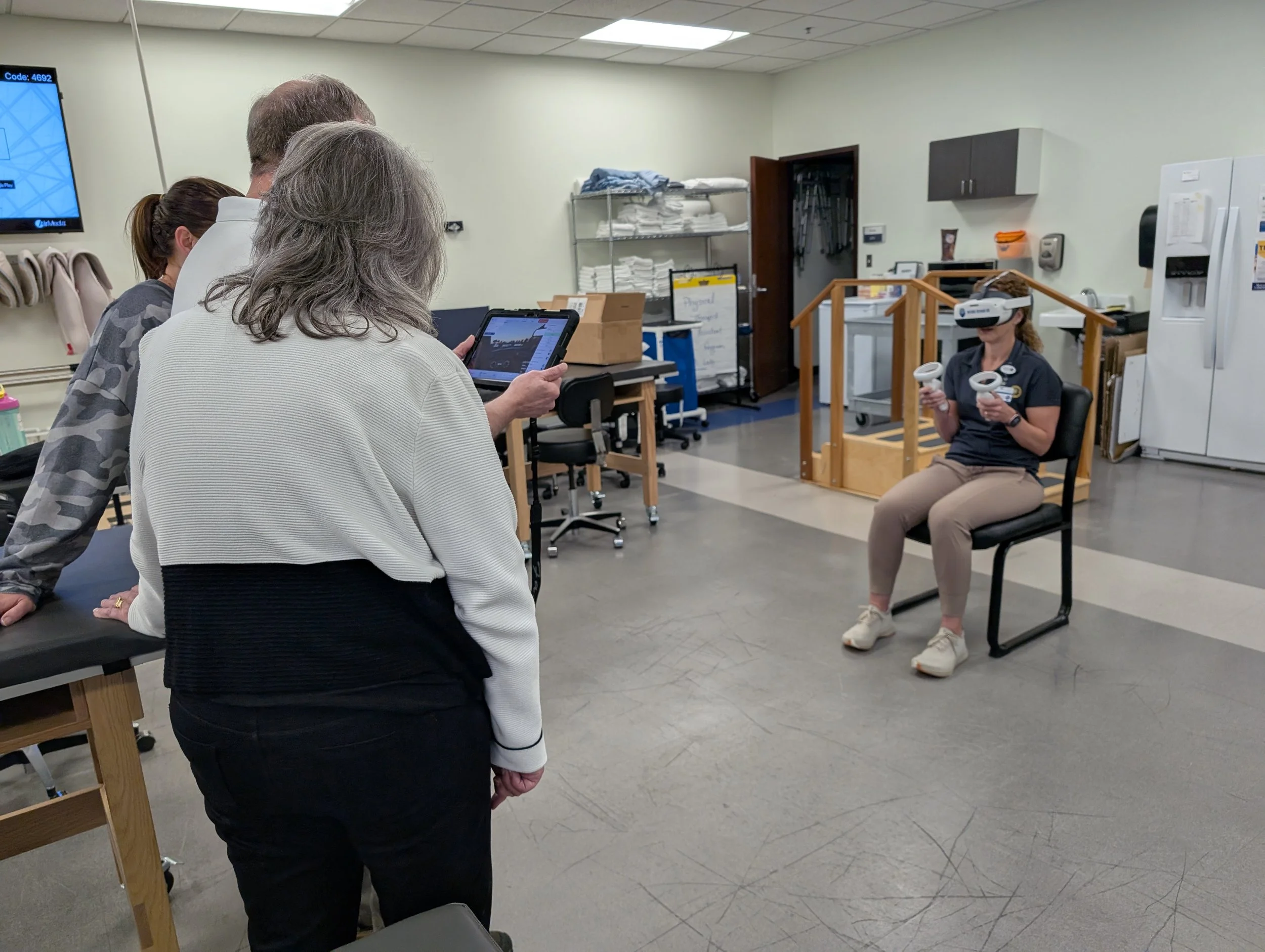
October is National Physical Therapy Month, the time each year when the American Physical Therapy Association celebrates the profession and raises awareness of how physical therapists and physical therapist assistants improve health, mobility, and quality of life across the lifespan (American Physical Therapy Association). It is also a fitting moment to recognize one of the most skilled parts of a therapist's work, which is helping patients carry what they learn in the clinic into the places where they actually live.
Every therapy gym is designed with good intentions. The lighting is even, the floors are level, the hallway is clear, and the only voice the patient needs to follow belongs to the therapist standing beside them. Those conditions make it possible to teach a movement safely and measure it reliably, which is exactly why clinics are built that way. The challenge is that patients do not live in therapy gyms, and the world they return to is louder, busier, less predictable, and far more demanding of their attention.
Many clinicians will recognize the pattern this creates. A patient walks confidently during a timed test in a quiet corridor, then reports feeling unsteady in a grocery store aisle, a crowded parking lot, or a family gathering where several conversations happen at once. The patient has not lost the skill they practiced in the clinic. What changed is the environment, and the research suggests that environmental complexity deserves a more deliberate place in how rehabilitation is planned, delivered, and measured.
Capacity and Performance Are Not the Same Thing
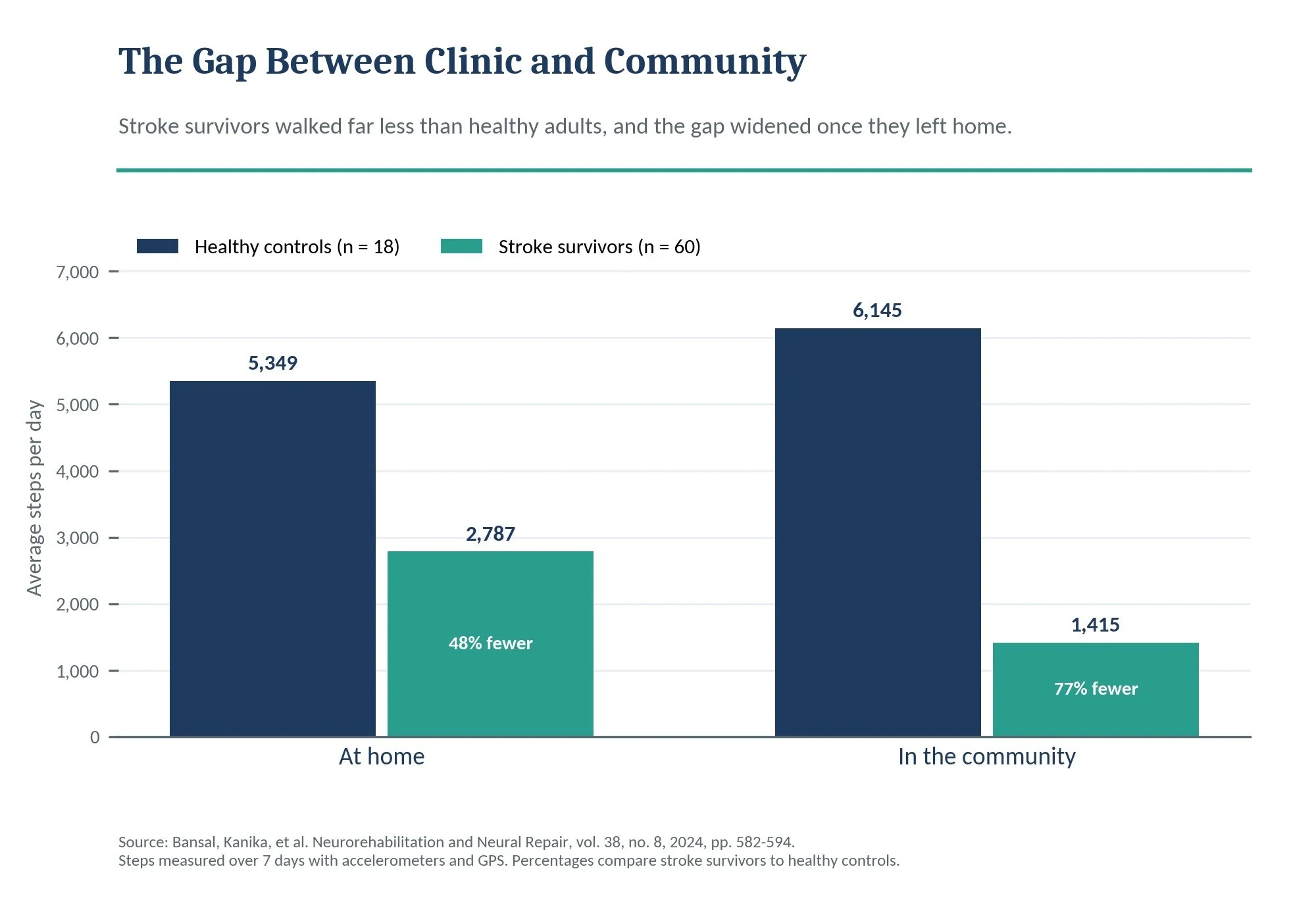
Rehabilitation researchers draw a useful distinction between capacity, which describes what a person can do in a structured setting, and performance, which describes what that person actually does in daily life. Bansal and colleagues note that somewhere between 65 and 85 percent of stroke survivors regain the ability to walk independently in controlled settings such as the home or clinic, yet many continue to face limitations when walking in the community (Bansal et al. 582). They also point out that walking capacity may explain only 30 to 50 percent of the variance in real-world walking performance, which leaves a large share of daily function shaped by other factors (Bansal et al.).
Their 2024 study in Neurorehabilitation and Neural Repair made this gap visible by pairing step monitors with GPS devices to track where 60 stroke survivors actually walked over seven days. Stroke survivors took 48 percent fewer steps at home and 77 percent fewer steps in the community than age-matched and location-matched healthy controls (Bansal et al.). Even more telling, participants with medium and high gait speed or endurance scores did not differ from each other in their real-world home or community steps, despite large differences on the clinical tests themselves (Bansal et al.). The authors concluded that clinicians should be cautious about predicting community ambulation from clinical measures alone, and they identified balance confidence, motivation, and stress responses during outdoor walking as factors that can influence real-world mobility regardless of gait speed (Bansal et al.).
None of this means clinical testing is flawed. It means a clinic score tells us what a patient is capable of under specific conditions, and the conditions of everyday life add demands that a quiet hallway was never designed to capture.
The Five Demands the Clinic Usually Removes
Environmental complexity is not a single variable. It arrives as a combination of demands that compete for the same limited attention and postural control, and each one can change how a patient moves. Although much of the research in this post comes from stroke and vestibular populations, the same demands face older adults, people living with Parkinson's disease, and patients returning to work or school after an injury.
-
In Free Roam, patients explore peaceful terrain at their own pace, come across wildlife along the way and stop for breathing exercises whenever they like. There is no score to chase, no timer running and no wrong turn to take, and that is exactly the point.
After a stroke, a serious injury or a long hospital stay, so much of a patient's day is decided for them. Someone else sets their schedule, their exercises and often their meals. Letting a patient choose where to walk next, even in a virtual world, hands back a small but meaningful sense of control. I tend to use Free Roam as a lower-pressure stretch of the session for patients who are dealing with pain or who seem overwhelmed, because it keeps them engaged without asking them to perform.
-
Guided Breathing walks patients through box breathing, a simple pattern of breathing in, holding, breathing out and holding again, each for the same count. Most of my patients have been told to "just take a deep breath" more times than they can remember, and in a stressful moment it is hard to know how. Instead of counting in their heads, they follow visual pacing cues while calming nature scenery surrounds them, which makes it much easier to stay with the rhythm.
Because it only takes a few minutes, Guided Breathing fits naturally into a session in several places. I often use it right before a demanding task, like a transfer or a balance challenge the patient has been nervous about. It is just as useful right after a frustrating attempt, to help the patient settle before trying again. And at the end of a session, it makes a calm cool-down, so patients leave feeling steady instead of drained.
-
At a quiet lakeside, patients cast a line, track it on the water and reel in their catch. The activity combines relaxation with sustained attention and hand-eye coordination, so there is real therapeutic work happening underneath the calm.
Plenty of my patients have told me that sitting still and "just relaxing" is harder for them than any exercise I could give them. For those patients, Fishing is a great fit. It gives their hands and their attention something to do, so the calm comes from being absorbed in an activity rather than from being asked to switch off, and they never feel like therapy has stopped.
-
In the Auditory Exercise, patients listen for sounds and work out where they are coming from in a full 360° environment. It trains sustained attention and auditory processing, and it does so in a quiet setting with no time pressure.
That combination makes it especially useful for patients who are working on attention but get overwhelmed by the noise and activity of a busy clinic. I also like it as a next step after a breathing reset, when I want to bring a patient's focus back up gradually before we return to more demanding work.
-
Unfamiliar or crowded settings can also raise stress and fear of falling, which affects how freely a person moves. Bansal and colleagues cite their own earlier work showing that stress responses during outdoor walking tasks can influence home and community walking behavior independent of gait speed and endurance (Bansal et al.). A patient who feels watched, rushed, or uncertain may move very differently than the same patient in a calm treatment room.
Why the Quiet Clinic Can Hide the Problem
Because clinics remove these demands, they can unintentionally mask the deficits that matter most once a patient goes home. A systematic review by Deblock-Bellamy and colleagues observed that the dual-task research on stroke survivors had largely examined walking on simple paths, and that the absence of complex locomotor tasks such as obstacle negotiation limited what those findings could tell clinicians about community life (Deblock-Bellamy et al.). Tsang and colleagues similarly call for standardized assessments that include distinct cognitive domains, so clinicians can build a fuller profile of how dual-task demands affect each patient (Tsang et al., "Effects of Cognitive Task Type").
The practical problem is that recreating real-world complexity in a clinic has always been difficult. Taking a patient into a parking lot or a busy store introduces safety risks, changes from one visit to the next, and offers no reliable way to adjust the challenge in small, measurable steps. Faria and colleagues note in their systematic review that practicing in real environments can be dangerous for people with acquired brain injury, and that this concern has motivated the use of virtual reality to recreate real-world settings safely (Faria et al.).
What Immersive Reality Adds to Treatment
Virtual reality offers something the physical clinic cannot easily provide, which is real-world complexity that can be controlled, repeated, and graded. Faria and colleagues identify presence, plausibility, and embodiment as elements that collectively contribute to the ecological validity of VR-based assessment and rehabilitation, meaning the degree to which training in a virtual setting reflects demands found in daily life (Faria et al.).
The evidence for training under complex conditions is encouraging. In the V-TIME randomized controlled trial published in The Lancet, adults aged 60 to 90 with a history of two or more falls received six weeks of either treadmill training alone or treadmill training combined with a virtual reality component designed to challenge the cognitive aspects of safe walking (Mirelman et al. 1170). Six months after training ended, the virtual reality group had a significantly lower fall rate, with an incident rate ratio of 0.58 compared to treadmill training alone (Mirelman et al. 1170). That trial used a non-immersive, screen-based system, yet its results support a principle that applies across formats, which is that practicing mobility while managing environmental and cognitive demands can carry over into fewer real-world falls. That outcome reflects the prevention focus APTA is highlighting this October through its PT For Future Me campaign, which encourages the public to view physical therapy as support for prevention, movement, and resilience rather than only as care after an injury or surgery (American Physical Therapy Association).
Immersive environments have also shown promise for patients whose symptoms are driven by visual complexity. In a pilot study of 16 patients with unilateral peripheral vestibular disorders, Pavlou and colleagues compared vestibular exercises performed in a static versus a dynamic virtual crowded square and concluded that exposure to dynamic virtual environments should be considered a useful adjunct to vestibular rehabilitation for patients with visual vertigo (Pavlou et al. 273). Pilot data like these call for larger trials, but they point toward a clear clinical idea, which is that patients can build tolerance to busy visual scenes through gradual, supervised exposure that would be hard to arrange in the real world.
How Smart Therapy Brings the Environment Into the Treatment Room
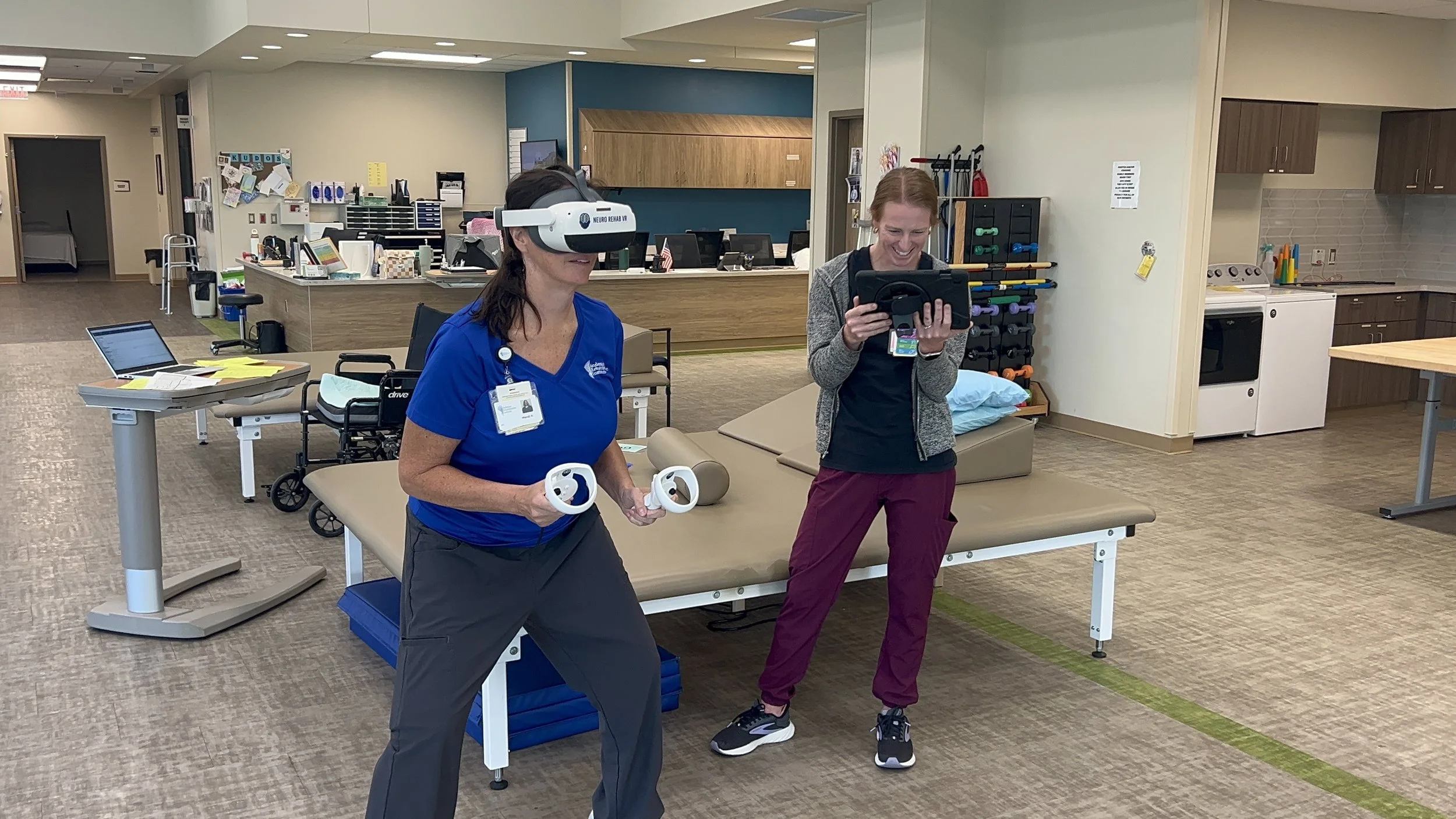
Smart Therapy™ was built inside a working neuro outpatient clinic, by people who saw this gap between clinic performance and daily life firsthand. The platform pairs an immersive VR headset worn by the patient with a tablet controlled by the therapist, and it organizes the clinical workflow around four connected functions: Plan, Treat, Measure, and Document. Each function plays a role in helping patients carry their gains into more demanding environments.
-
Therapists can plan sessions around the environmental demands that matter for each patient's goals. A patient preparing to return to grocery shopping, community walking, or a busy workplace needs different challenges than a patient focused on safe transfers at home, and Smart Therapy gives clinicians a structured way to build those demands into a progression from the start.
-
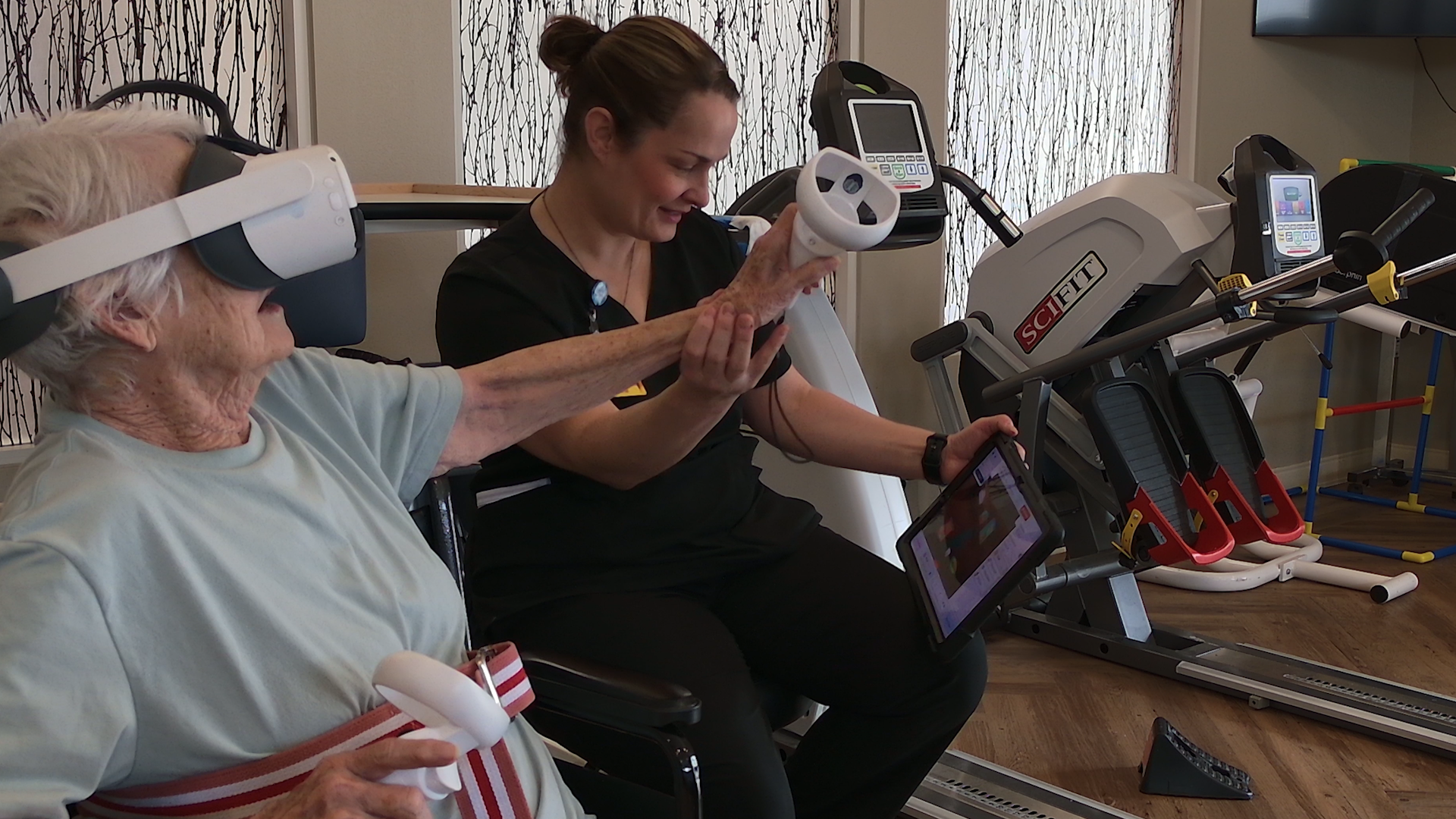
During the session, the patient is immersed in a virtual environment while the therapist uses the tablet to see what the patient sees and adjust exercise settings in real time. This allows the clinician to find the setting that is challenging but still achievable, then raise or lower the difficulty as the patient responds. Instead of choosing between a calm clinic and an unpredictable real-world outing, the therapist can introduce complexity gradually, within a safe and supervised space, and stay in control of every step.
-
On eye-tracking-enabled headsets, Smart Therapy adds a layer of insight into where a patient is directing their visual attention during an exercise. Research supports the value of this approach. Kaiser and colleagues note in a systematic review that conventional assessments often fail to detect milder forms of unilateral spatial neglect, and that immersive VR combined with eye tracking has the potential to overcome those shortcomings (Kaiser et al.). Norwood and colleagues found that attention maps generated from gaze, controller, and headset movement in VR identified spatial biases in brain-injured patients and presented attention strengths and weaknesses in a format clinicians found visually effective (Norwood et al.). For a patient who struggles in visually busy settings, this kind of data can help a therapist understand what is happening beyond what can be observed from the outside.
-
Progression through environmental challenges only helps a care team when it is captured clearly. Smart Therapy's AI documentation supports therapists in recording what the patient did and under what conditions, so that gains in a more demanding environment become part of the clinical record rather than a detail that lives only in the therapist's memory. That record also helps communicate a patient's readiness for community activities to the rest of the care team.
Clinician Judgment Still Sets the Course
Immersive technology gives therapists more control over environmental complexity than they have ever had inside a clinic, and that control is most valuable in the hands of a skilled clinician. Deciding which demands to introduce, when a patient is ready to progress, and how virtual practice should connect to real-world goals remains a clinical decision. Smart Therapy is designed to support that judgment by making complex environments safe to practice in, easy to adjust, and simple to measure and document.
Closing the Gap Between the Clinic and Daily Life
A patient who can complete an exercise in a quiet room has achieved something real, and that progress deserves recognition. The next question is whether they can do it with noise in the background, movement in their peripheral vision, an uneven path ahead, and a conversation to follow at the same time. Research on community ambulation and dual-task interference makes it clear that this question cannot be fully answered in a calm clinic alone. Immersive reality gives therapists a way to bring the demands of everyday life into treatment deliberately, so patients can practice the environment along with the exercise before they face it on their own.
This National Physical Therapy Month, we want to thank the physical therapists and physical therapist assistants who do this work every day. Their skill in reading each patient, adjusting the challenge, and preparing people for the realities of daily life is what turns progress in the clinic into independence at home and in the community.
-
American Physical Therapy Association. "National Physical Therapy Month: Celebrate, Engage, and Raise Awareness." APTA, 9 Sept. 2026, www.apta.org/article/2026/09/09/national-physical-therapy-month-celebrate-engage-and-raise-awareness.
Bansal, Kanika, et al. "Speed- and Endurance-Based Classifications of Community Ambulation Post-Stroke Revisited: The Importance of Location in Walking Performance Measurement." Neurorehabilitation and Neural Repair, vol. 38, no. 8, 2024, pp. 582-594, doi.org/10.1177/15459683241257521.
Deblock-Bellamy, Anne, et al. "Cognitive-Locomotor Dual-Task Interference in Stroke Survivors and the Influence of the Tasks: A Systematic Review." Frontiers in Neurology, vol. 11, 2020, article 882, doi.org/10.3389/fneur.2020.00882.
Faria, Ana Lúcia, et al. "Ecologically Valid Virtual Reality-Based Technologies for Assessment and Rehabilitation of Acquired Brain Injury: A Systematic Review." Frontiers in Psychology, vol. 14, 2023, article 1233346, doi.org/10.3389/fpsyg.2023.1233346.
Kaiser, Alexander Pilski, et al. "Virtual Reality and Eye-Tracking Assessment, and Treatment of Unilateral Spatial Neglect: Systematic Review and Future Prospects." Frontiers in Psychology, vol. 13, 2022, article 787382, doi.org/10.3389/fpsyg.2022.787382.
Mirelman, Anat, et al. "Addition of a Non-Immersive Virtual Reality Component to Treadmill Training to Reduce Fall Risk in Older Adults (V-TIME): A Randomised Controlled Trial." The Lancet, vol. 388, no. 10050, 2016, pp. 1170-1182, doi.org/10.1016/S0140-6736(16)31325-3.
Norwood, Michael F., et al. "Creating Maps of Attention Using Virtual Reality for Brain-Injured and Spatial Neglect Patients." Journal of Head Trauma Rehabilitation, vol. 37, no. 6, 2022.
Pavlou, Marousa, et al. "The Effect of Virtual Reality on Visual Vertigo Symptoms in Patients with Peripheral Vestibular Dysfunction: A Pilot Study." Journal of Vestibular Research, vol. 22, no. 5, 2012, pp. 273-281.
Tsang, Charlotte Sau Lan, et al. "Degree and Pattern of Dual-Task Interference during Walking Vary with Component Tasks in People after Stroke: A Systematic Review." Journal of Physiotherapy, vol. 68, no. 1, 2022, pp. 26-36, doi.org/10.1016/j.jphys.2021.12.009.
Tsang, Charlotte Sau Lan, et al. "Effects of Cognitive Task Type and Complexity on Dual-Task Interference During Level-Ground Walking and Obstacle Negotiation in Individuals with Stroke." Neurorehabilitation and Neural Repair, 2025, doi.org/10.1177/15459683251340930.