How to Make Rehab Accessible for People With Cerebral Palsy
Written by: Brianna Hodge
People with cerebral palsy move through the world in many different ways, and rehabilitation is one of the places where those differences show up most clearly. That makes it worth asking a quieter question about how therapy and rehabilitation technology are designed. When a patient struggles with an exercise, who is expected to change? In many clinical settings, the unspoken answer is the patient, because the activity is fixed, the setup is standard, and success is often judged by how closely a person's movement matches an expected pattern.
This article makes the case for a different starting point. Rehabilitation works best when the therapy, the environment, and the technology are as adaptable as the people they serve. Experienced clinicians already adjust activities constantly, but the idea deserves fresh attention as rehabilitation technology becomes a bigger part of everyday practice. Cerebral palsy offers a clear lens for this conversation because it is defined by variation, and immersive virtual reality offers a practical example of how adaptable tools can support individualized care rather than standardize it.
Different Movement Is Not Less Meaningful Movement
Cerebral palsy is not a single presentation. The widely used consensus definition describes it as a group of permanent disorders of movement and posture development that cause activity limitation, and it notes that the motor disorders are often accompanied by differences in sensation, perception, cognition, communication, and behavior (Rosenbaum et al.). In practice, two people with the same diagnosis may move in entirely different ways. One person may have spasticity concentrated on one side of the body, while another experiences involuntary movements that affect timing and accuracy in both arms. Range of motion, coordination between joints, motor planning, and sensory processing can all vary, and a systematic review of virtual reality interventions in cerebral palsy identifies this heterogeneity as one of the core challenges of applying motor learning principles in clinical practice (Demers et al.).
Positioning and fatigue add further layers. Some individuals participate most effectively from a wheelchair or a supported seated position, while others benefit from standing practice with the right support. Fatigue also shapes what a productive session looks like. A systematic review found that during submaximal tasks, including everyday physical activities, people with cerebral palsy reported or demonstrated more fatigue than typically developing peers (Puce et al.), and a meta-analysis of adult outcomes concluded that adults with cerebral palsy are, on average, fatigued and that a majority experience pain (van Gorp et al.). Cerebral palsy is lifelong, so these considerations follow people well past childhood and into adult rehabilitation settings.
None of this variation automatically limits what a person can achieve. Rosenbaum and Gorter's widely cited "F-words" framework, which builds on the World Health Organization's International Classification of Functioning, Disability and Health, encourages clinicians to focus on function, family, fitness, fun, friends, and future rather than on correcting impairments alone (Rosenbaum and Gorter). CanChild's summary of the framework describes functioning in terms of what people do, emphasizing that how something is done is not what matters most (CanChild). A patient who reaches for a cup with a different shoulder strategy, or completes a task more slowly but independently, is still participating, and that participation represents meaningful progress.
What Motor Learning Research Says About Getting the Challenge Right
The current international clinical practice guideline for improving physical function in children and young people with cerebral palsy reflects this person-centered shift. Its expert panel recommended that intervention include client-chosen goals, whole-task practice in real-life settings, support to empower families, and a team approach, and it advised clinicians to weigh age, ability, and child and family preferences when selecting specific interventions (Jackman et al.). A plain-language summary of the guideline adds that practice should be enjoyable and motivating, and that clinicians should identify whether the factors limiting goal achievement sit with the person, the task, or the environment (Mac Keith Press).
That last point is the heart of designing for differences. If the barrier lives in the task or the environment, then changing the task or the environment is a legitimate clinical strategy, not a shortcut. Motor learning theory helps explain why. Guadagnoli and Lee's challenge point framework proposes that the same motor task represents a different challenge for performers of different abilities, and that learning is best supported when task difficulty is matched to the individual's skill level (Guadagnoli and Lee). A task that is too easy offers little new information to learn from, while a task that is far too hard can produce repeated failure without useful learning. The optimal point is different for every person, and it moves as that person improves.
Motivation and autonomy matter as well. Wulf and Lewthwaite's OPTIMAL theory of motor learning draws on research showing that conditions which enhance a learner's expectations for success, support their autonomy, and direct attention toward the intended effect of a movement all contribute to performance and learning (Wulf and Lewthwaite). For someone whose movement differs from a "typical" pattern, an activity designed around another person's body can quietly erode expectations of success before practice even begins. An activity that fits, in contrast, gives the person a real chance to succeed, try again, and build confidence along the way.
Immersive Environments as Adjustable Practice Spaces
This is where rehabilitation technology can either open doors or close them. Demers and colleagues reviewed 26 studies of virtual reality interventions for upper limb function in cerebral palsy and found that difficulty progression was poorly incorporated, especially in commercial video game platforms. None of the commercial game studies reported whether games were adapted to match a participant's capacity, and the authors noted that games designed for nondisabled players may set minimum thresholds that some people with cerebral palsy cannot reach in order to progress (Demers et al.). Accessibility research points in the same direction. In interviews with 16 people with limited mobility, Mott and colleagues found that many participants' abilities did not match the assumptions built into mainstream VR systems, and they identified seven physical accessibility barriers ranging from initial setup to keeping controllers in view of the headset's cameras (Mott et al.).
The takeaway is not that immersive technology is inherently accessible or inaccessible, but that adaptability has to be designed in from the start. The same review observes that virtual environments offer a distinct opportunity to customize task difficulty by changing spatial and temporal constraints and cognitive challenge, to vary how feedback is delivered, and to record task outcomes automatically, and it recommends that software be flexible enough for clinicians to adjust practice variability within a block of trials (Demers et al.). Levin, Weiss, and Keshner similarly describe enriched virtual environments as a way to optimize motor learning by manipulating practice conditions that engage motivational, cognitive, motor control, and feedback-based learning mechanisms (Levin et al.).
In practical terms, an adaptable immersive environment lets a clinician change the activity instead of asking the patient to change their body to fit it. Targets can be placed within a person's available range of motion and moved gradually outward as that range improves. Pace can slow down for someone whose movements take more time to plan and execute, or speed up for someone ready for a greater challenge. Positioning can shift between seated and standing practice depending on postural control, endurance, and the goal of the session. Cognitive demands can rise or fall by changing how many decisions a task requires, while environmental complexity can range from a calm, simple scene to one with more visual information and distraction. Feedback can be tuned as well, which matters because the Demers review cautions that continuous feedback may limit exploration and long-term retention, while faded or self-controlled feedback may better support lasting learning (Demers et al.).
What these adjustments share is that a clinician makes them. An immersive environment does not know a patient's goals, history, fatigue patterns, or what a good day looks like for that individual, but the clinician does. Technology can make it faster and easier to act on clinical judgment by changing a parameter mid-session or repeating a task at a slightly different setting, while the judgment itself remains human. Levac, Huber, and Sternad also remind the field that transfer from virtual practice to real-world performance should not be assumed, and that how closely a virtual task reproduces the real one can influence what carries over (Levac et al.). That is one more reason clinicians, not software, should decide how immersive practice fits into a broader plan of care built around functional goals.
A Real-World Example: Smart Therapy™ Complete Solution by Neuromersive
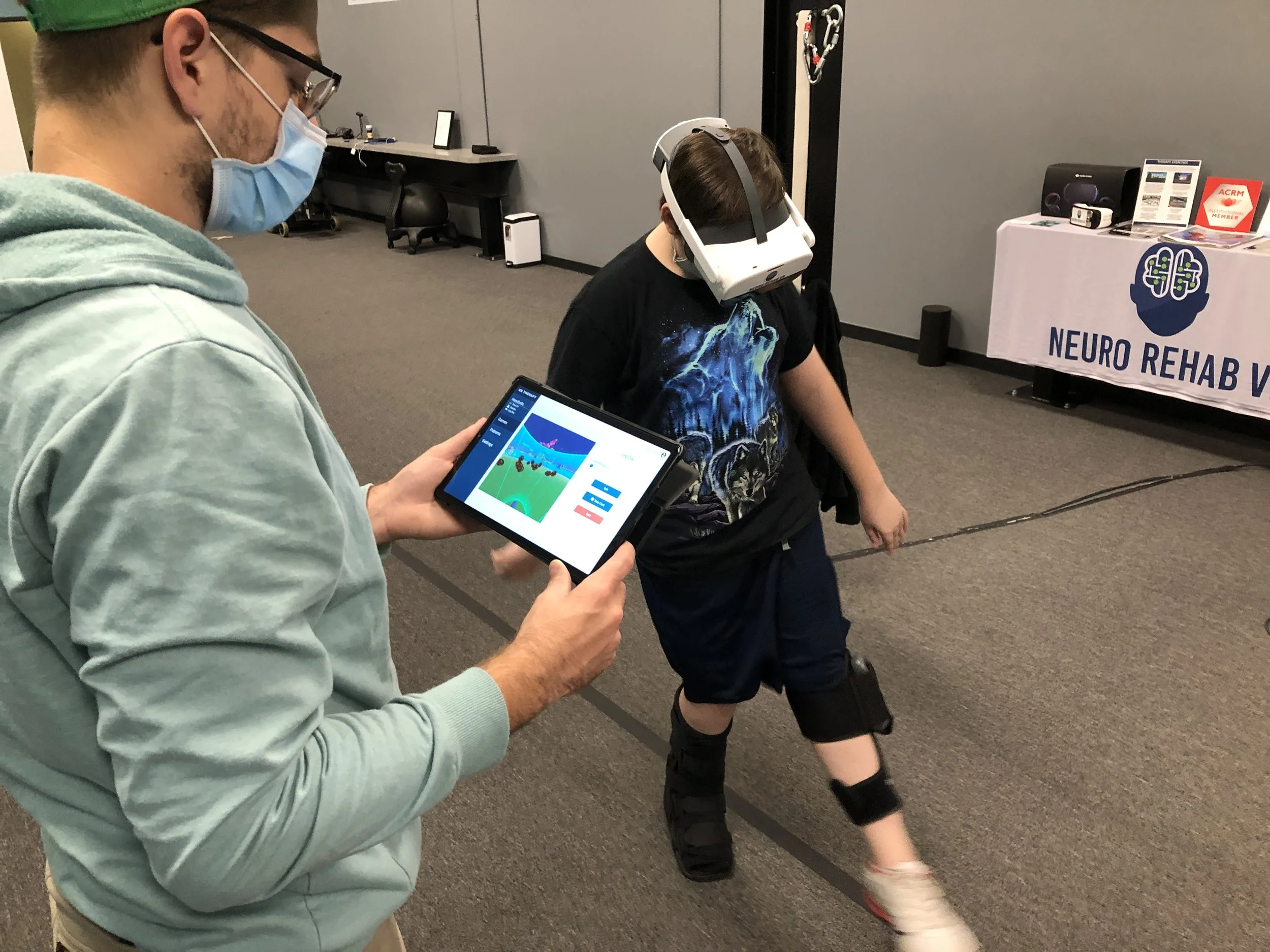
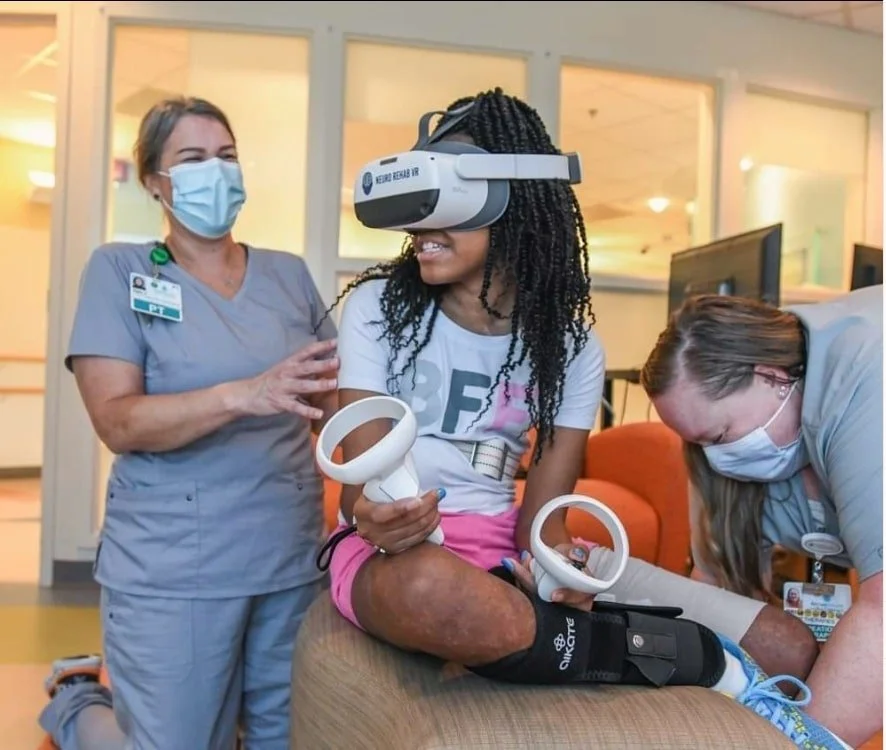
The Smart Therapy™ Complete Solution by Neuromersive offers one example of how these principles can show up in everyday clinical practice. The platform is used across neurological, orthopedic, and wellness-focused rehabilitation with patients from pediatric to geriatric ages, rather than being built for a single diagnosis, which makes adaptability a practical necessity. A patient wears a wireless VR headset while the therapist uses a paired tablet to see exactly what the patient sees and adjust exercise variables in real time, looking for a level that is challenging but achievable. That arrangement puts the challenge point idea into daily practice, because difficulty can respond to what the clinician observes rather than staying locked to a preset game level.
Several features support the kinds of adaptations described above. Activities can be completed in seated, standing, or elevated supine positions, so clinicians can match the setup to a patient's postural control, endurance, and stage of recovery instead of building the session around one expected posture. Seated access supports wheelchair users and people earlier in recovery, while standing activities support weight-bearing and gait-focused goals. A single-side mode allows practice to focus on one side of the body, which can be valuable for people whose movement differences are concentrated on one side. Real-time activity customization lets clinicians tailor each exercise to an individual's current functional level, and clinician-controlled progression keeps decisions about when and how to increase the challenge in the therapist's hands. Functional and ADL-based experiences, such as functional reaching and a grocery shopping simulation, connect practice to everyday tasks and reflect the guideline emphasis on whole-task practice of goals that matter to the person (Jackman et al.).
Performance metrics round out the picture. Neuromersive organizes the platform around four connected clinical functions: Plan, Treat, Measure, and Document. Objective movement data is captured automatically during each session, supporting the measurement side of that workflow, and the AI-powered Pro tier can turn session data into a clinician-ready SOAP note. These metrics can help clinicians track change over time, compare performance across different settings, and describe progress in terms that reflect what the patient can actually do. When a patient's performance dips late in a session, for example, the data gives the clinician one more piece of information to weigh alongside their own observations about fatigue, effort, and engagement.
These features are designed to work alongside clinicians. The therapist still sets goals with the patient, chooses activities, interprets performance, and decides how immersive practice fits within the broader plan of care. What the platform contributes is flexibility, giving clinicians more ways to say yes to a patient whose movement does not fit a standard template.
Creating More Ways In
People with cerebral palsy deserve the same chance as anyone to participate fully in the activities that matter to them. Rehabilitation has a meaningful role in that goal, and it begins with how we design the experiences we ask people to engage in. When an activity assumes one way of moving, one position, one pace, or one level of endurance, it quietly decides who gets to participate. When it is built to adapt, it widens the door for everyone who comes through it.
Designing therapy for differences rather than deficits does not mean lowering expectations. It means setting the right challenge for the right person, recognizing that different movement can still be skilled and purposeful movement, and measuring progress by participation and function rather than by resemblance to a textbook pattern. Immersive technology is one tool that can help clinicians do this, and it works best when it is designed to adapt and guided by the people who know their patients well. That goal is worth carrying into every session: more ways for every person to take part in meaningful rehabilitation, on terms that fit who they are
-
CanChild Centre . “F-Words in Childhood Disability | CanChild.” Canchild.Ca, canchild.ca/en/research-in-practice/f-words-in-childhood-disability. Accessed 7 Oct. 2026.
Demers, Marika, et al. “Integration of Motor Learning Principles Into Virtual Reality Interventions for Individuals With Cerebral Palsy: Systematic Review.” JMIR Serious Games, vol. 9, no. 2, 7 Apr. 2021, p. e23822, 10.2196/23822.
Guadagnoli, Mark A., and Timothy D. Lee. “Challenge Point: A Framework for Conceptualizing the Effects of Various Practice Conditions in Motor Learning.” Journal of Motor Behavior, vol. 36, no. 2, July 2004, pp. 212–224, 10.3200/jmbr.36.2.212-224.
Jackman, Michelle, et al. “Interventions to Improve Physical Function for Children and Young People With Cerebral Palsy: International Clinical Practice Guideline.” Developmental Medicine & Child Neurology, vol. 64, no. 5, 21 Sept. 2021, pp. 536–549, onlinelibrary.wiley.com/doi/10.1111/dmcn.15055, 10.1111/dmcn.15055. Accessed 7 Oct. 2026.
Levac, Danielle E, et al., 31627755. “Learning and Transfer of Complex Motor Skills in Virtual Reality: A Perspective Review.” Journal of Neuroengineering and Rehabilitation, vol. 16, no. 1, 18 Oct. 2019, p. 121. PubMed Central, pubmed.ncbi.nlm.nih.gov/31627755/, 10.1186/s12984-019-0587-8. Accessed 7 Oct. 2026.
Levin, M. F., et al. “Emergence of Virtual Reality as a Tool for Upper Limb Rehabilitation: Incorporation of Motor Control and Motor Learning Principles.” Physical Therapy, vol. 95, no. 3, 11 Sept. 2014, pp. 415–425, www.ncbi.nlm.nih.gov/pmc/articles/PMC4348716/, 10.2522/ptj.20130579. Accessed 7 Oct. 2026.
Mac Keith Press. “Key Ingredients of Interventions to Improve Function in CP.” Cerebral Palsy Foundation, 9 Nov. 2023, cpresource.org/topic/treatment-options/key-ingredients-interventions-improve-function-cp. Accessed 7 Oct. 2026.
Mott, Martez, et al. “‘I Just Went Into It Assuming That I Wouldn’t Be Able to Have the Full Experience’ Understanding the Accessibility of Virtual Reality for People With Limited Mobility.” The 22nd International ACM SIGACCESS Conference on Computers and Accessibility (ASSETS ’20), 2020, par.nsf.gov/servlets/purl/10230840, 10.1145/3396956.3396969. Accessed 7 Oct. 2026.
P, Rosenbaum, et al. “A Report: The Definition and Classification of Cerebral Palsy April 2006.” Developmental Medicine and Child Neurology. Supplement, 1 Feb. 2007, pubmed.ncbi.nlm.nih.gov/17370477/. Accessed 7 Oct. 2026.
Puce, Luca, et al. “Systematic Review of Fatigue in Individuals With Cerebral Palsy.” Frontiers in Human Neuroscience, vol. 15, 15 Mar. 2021, 10.3389/fnhum.2021.598800.
Rosenbaum, P., and J. W. Gorter. “The ‘F-Words’ in Childhood Disability: I Swear This Is How We Should Think!” Child: Care, Health and Development, vol. 38, no. 4, 1 Nov. 2011, pp. 457–463, onlinelibrary.wiley.com/doi/10.1111/j.1365-2214.2011.01338.x, 10.1111/j.1365-2214.2011.01338.x. Accessed 7 Oct. 2026.
van Gorp, Marloes, et al. “Epidemiology of Cerebral Palsy in Adulthood: A Systematic Review and Meta-Analysis of the Most Frequently Studied Outcomes.” Archives of Physical Medicine and Rehabilitation, vol. 101, no. 6, June 2020, pp. 1041–1052, repub.eur.nl/pub/126053, 10.1016/j.apmr.2020.01.009. Accessed 7 Oct. 2026.
Wulf, Gabriele, and Rebecca Lewthwaite. “Optimizing Performance Through Intrinsic Motivation and Attention for Learning: The OPTIMAL Theory of Motor Learning.” Psychonomic Bulletin & Review, vol. 23, no. 5, 29 Jan. 2016, pp. 1382–1414, 10.3758/s13423-015-0999-9.