
Written by: Brianna Hodge
A patient recovering from a stroke needs to relearn how to reach for a cup. A patient with a sports concussion needs their smooth pursuit eye movements screened before they return to the field. A patient with Parkinson's disease needs a clinician who can grade the difficulty of a balance task in real time and document the session before the next patient walks in. These are three different clinical problems, and no single piece of hardware solves all three.
For the past several years, the conversation around technology in rehabilitation has centered on one question: is virtual reality (VR) or augmented reality (AR) the better tool?
Clinicians do not need to pick a side though. They need a system that gives them VR when immersion serves the goal, AR when the real environment matters more, eye tracking when oculomotor function needs to be measured, and documentation support that keeps pace with all of it. That is the shift from "VR therapy" to Rehabilitation Intelligence, and it is the idea behind Smart Therapy™. Today, the platform delivers VR, eye tracking, and AI-supported documentation inside that connected model, and AR-informed exercises are next on its roadmap.
Why the VR-or-AR Debate Misses the Point
Virtual reality and augmented reality solve different problems because they work in fundamentally different ways. VR replaces the patient's visual field with a fully computer-generated environment, cutting off the outside world through a head-mounted display. AR overlays digital elements onto the patient's actual physical surroundings, so the real room, the real furniture, and the real body stay in view (Nelson et al.). That single difference in design changes what each technology is good for.
Immersive VR has a long track record in motor rehabilitation. In one of the earlier controlled case studies, three chronic stroke patients completed a two-week program combining real-object dexterity tasks with VR simulations targeting range of motion, movement speed, and force production, and two of the three patients improved on a standardized hand function test by the end of the intervention (Merians et al.). The mechanism behind results like these is tied to how VR can recruit the mirror neuron system: watching a virtual representation of an affected limb move can help reactivate the motor pathways connected to that limb, particularly after stroke (Schollmeier). Immersion also lets a clinician precisely control the intensity, feedback, and challenge level of a task, something that is difficult to standardize in a conventional gym setting (Leong et al.).
AR earns its place for a different reason. Because the patient stays inside their own physical space, AR-based rehabilitation can put a training task in the same context where the skill will actually be used, whether that is a kitchen counter, a hallway, or a set of stairs. A 2025 systematic review in the Journal of NeuroEngineering and Rehabilitation found that AR environments that emulate real-life scenarios can increase adherence and support more individualized rehabilitation, particularly for lower-limb recovery (Liu et al.). A 2025 meta-analysis reached a similar conclusion, finding functional benefits from AR-based physiotherapy across multiple patient populations while calling for larger, more rigorously controlled trials (Viñolo Gil et al.).
Neither modality is more advanced than the other. They are built for different clinical jobs. A patient relearning a functional task at home benefits from an environment that mirrors home. A patient who needs graded, repeatable, high-intensity motor practice benefits from an environment a clinician can fully control. Forcing every patient through the same modality, whichever one a clinic happens to own, means some patients get a tool that fits the goal and others get a tool that does not.
Different Patients Need Different Tools, Sometimes in the Same Week
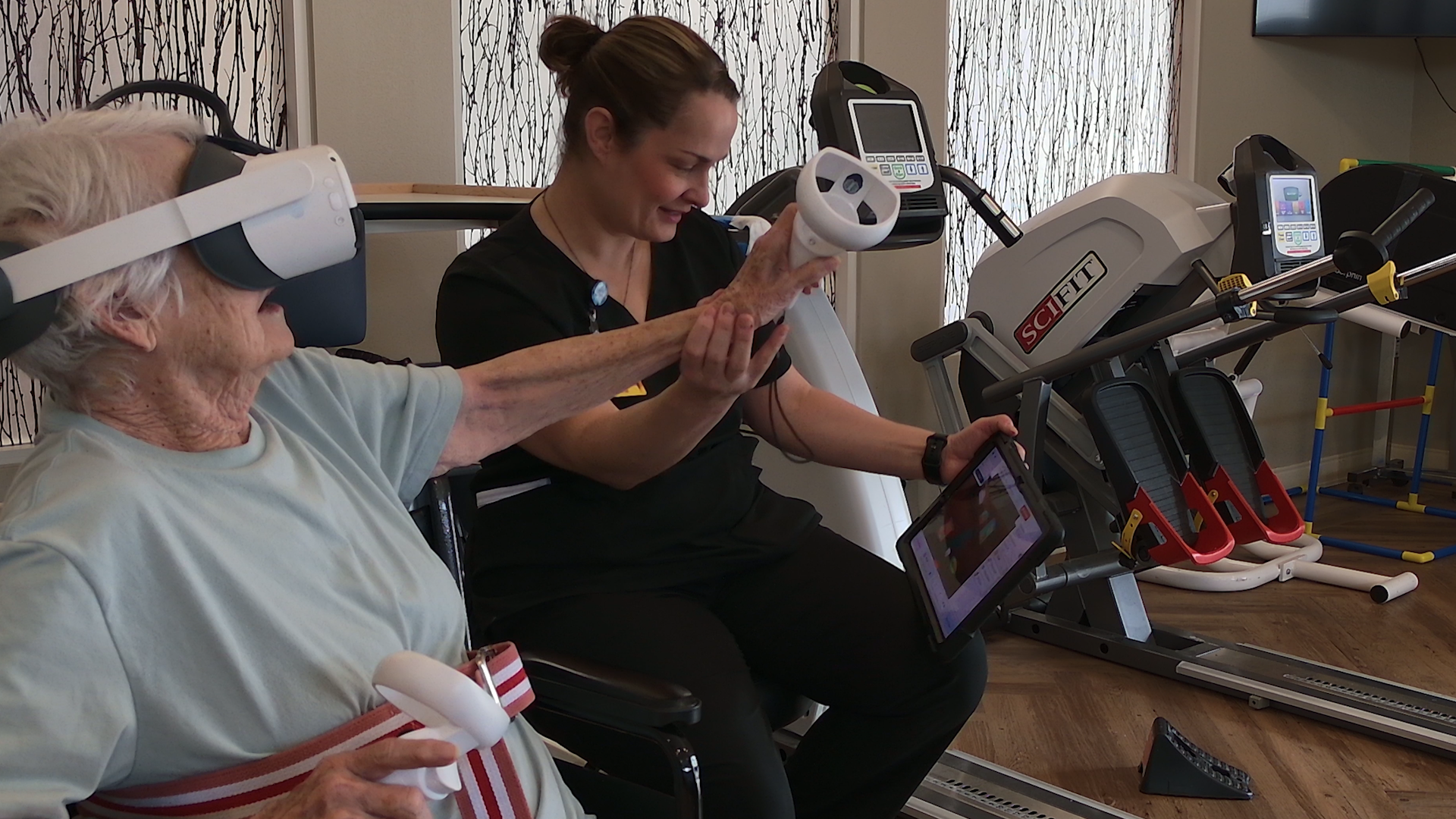
Consider a single outpatient caseload on a typical day. A stroke patient works on upper-limb reaching and needs the graded, repeatable practice that immersive VR is well suited to provide. An hour later, a pediatric patient with a developmental coordination disorder needs a task that connects to their actual home environment, which points toward AR. A high school athlete comes in for a post-concussion follow-up and needs an objective oculomotor screen before anyone talks about return to play. A geriatric patient recovering from a hip replacement needs a conventional balance and gait session, no headset at all, documented just as carefully as the rest.
None of these four patients are wrong to need what they need, and none of them should have to fit their care around whichever single modality happens to be bolted to the clinic's one headset. A rehabilitation team treating this range of conditions, which is the ordinary reality inside physical therapy, occupational therapy, and neuro rehabilitation clinics, cannot responsibly standardize on VR alone or AR alone. The technology has to follow the patient, not the other way around.
Eye Tracking Adds a Layer Neither Modality Covers Alone
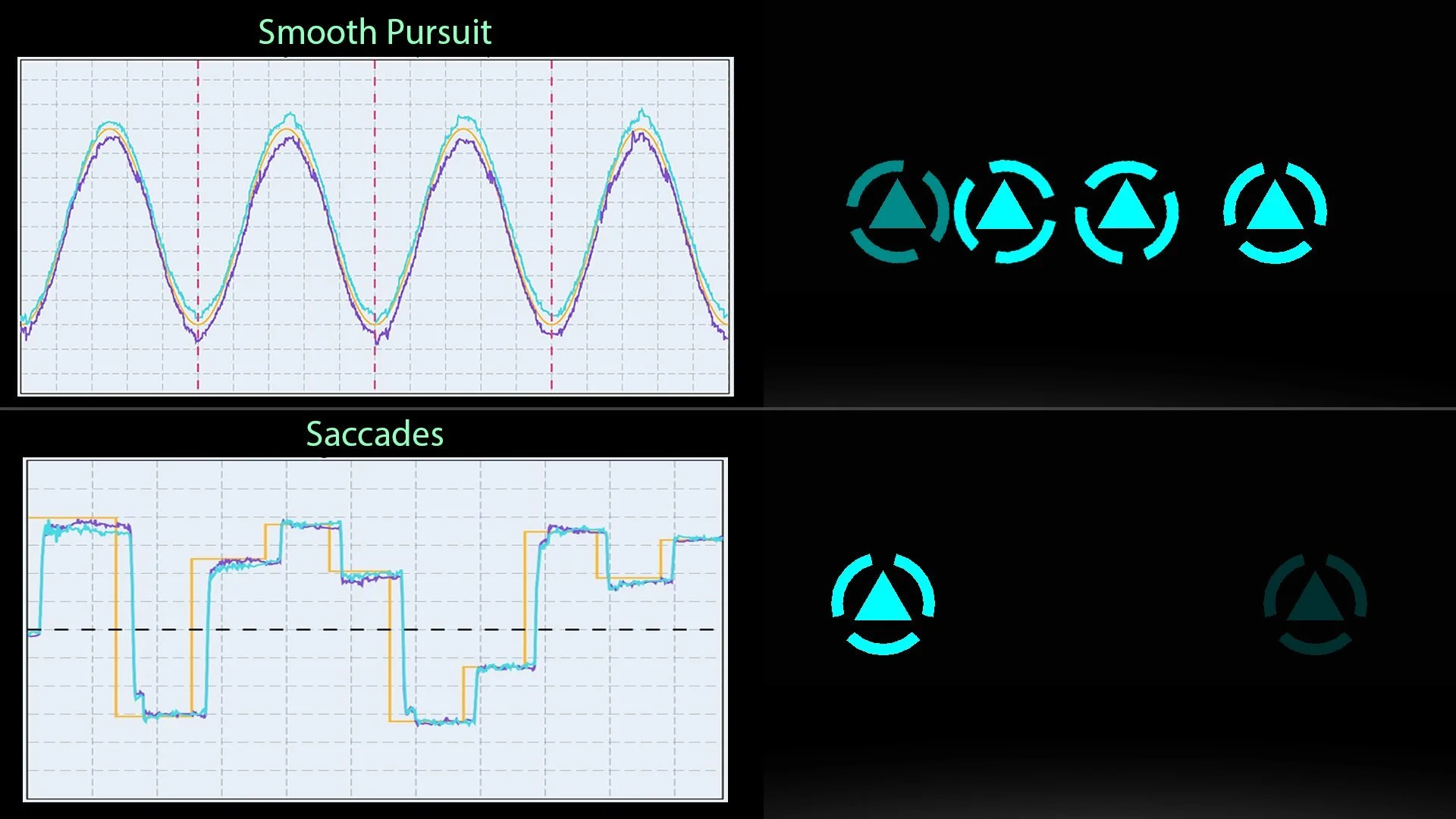
Motor recovery is only part of the picture in neuro rehabilitation. Oculomotor function, meaning how well a patient's eyes track, fixate, and coordinate with head movement, is frequently affected by concussion, stroke, and other neurological events, and it is just as frequently missed in a standard clinical exam. Vestibular and oculomotor deficits are common after concussion, and clinicians increasingly rely on structured screening tools to catch impairments in smooth pursuit, saccades, and convergence that would otherwise go unnoticed during a routine visit (Cochrane et al.PMC6445703).
Eye tracking technology gives clinicians something a manual finger-tracking test cannot: quantitative, repeatable data. A retrospective study at the Duke Eye Center vision rehabilitation clinic used automated eye tracking to evaluate saccade performance in patients with a history of concussion, and the authors concluded that the technology could provide objective, quantitative insight into the degree of oculomotor impairment, informing which patients would benefit from targeted vision rehabilitation (Song et al.). That kind of measurement matters because oculomotor deficits do not always announce themselves through obvious symptoms. A patient can look fine during a conversation and still have measurable smooth pursuit or saccadic impairment that affects reading, screen use, or return-to-sport timelines.
This is where the VR-versus-AR framing breaks down entirely. Eye tracking is not a competing modality. It is a diagnostic layer that can sit inside either a VR or an AR session, turning a therapy exercise into an assessment opportunity at the same time. A clinician does not have to choose between treating a patient and measuring them. The right platform lets both happen inside the same headset, during the same visit.
AI Documentation Closes the Loop, It Does Not Replace the Clinician
Every rehabilitation session generates information that has to end up somewhere: a note, a progress report, a justification for continued care. Documentation has become one of the most persistent sources of burnout across physical therapy, occupational therapy, and neuro rehabilitation, and it is not a new complaint. Multiple industry surveys and time-motion analyses describe documentation, coding, and compliance paperwork consuming a substantial share of a clinician's working day, with much of that work spilling into unpaid hours after clinic. A study of outpatient physical therapists, occupational therapists, and speech-language pathologists found that current documentation standards negatively affect clinical care, job satisfaction, and work-life balance, and that clinicians routinely trade off between spending time with a patient, finishing on time, and completing thorough notes.
AI-assisted documentation is starting to show measurable, if modest, relief. A prospective quality improvement study at a large academic medical center tracked an ambient AI scribe across 45 physicians in eight ambulatory disciplines and found that daily documentation time, after-hours EHR time, and total EHR time all decreased significantly over three months, even accounting for wide variation in how much individual clinicians used the tool (Ma et al.). A larger, two-year multisite study across five academic health systems, tracking more than 8,500 ambulatory clinicians, found that AI scribe adoption was associated with meaningful reductions in daily EHR and documentation time, concentrated most heavily among clinicians who used the tool in at least half of their visits (Jaslow). Neither study suggests AI documentation eliminates the need for clinical judgment. Both point to the same conclusion: when a system automatically captures what happened in a session, clinicians get time back to spend with patients instead of a keyboard.
For rehabilitation specifically, AI documentation only delivers real value when it is connected to what actually happened during the exercise, not typed in from memory afterward. A system that already knows how many repetitions a patient completed, how their balance responded to a difficulty adjustment, or what their eye tracking metrics looked like during a session can generate a note grounded in real data rather than a clinician's recollection at the end of a long day. That distinction matters more in rehabilitation than in a typical outpatient medical visit, because a rehab session is often a physical performance with numbers attached to it: repetitions, range of motion, latency, symmetry. An ambient scribe built for a conversation-based visit was never designed to capture that kind of quantitative, movement-based data. A documentation layer built into the therapy platform itself starts from the session's own measurements instead of trying to reconstruct them afterward.
The Real Opportunity Is the Connection, Not the Headset
None of this is an argument that VR is outdated, or that AR is the future, or that eye tracking and AI documentation are simply add-ons. It is an argument that the categories themselves are the wrong frame. A rehabilitation team managing a caseload that spans stroke, orthopedic recovery, pediatric development, and concussion does not need to standardize on one modality. It needs a workflow where the modality is a variable a clinician sets for each patient, not a fixed constraint of the equipment on hand.
Clinicians who work with virtual rehabilitation systems have long identified this as the actual bottleneck. Clinicians new to virtual rehabilitation need support not just in learning a device, but in the harder work of clinical decision making around system and activity selection, task grading, and documentation (Leong et al.). In other words, the technology itself was rarely the limiting factor. Knowing which tool to use, for which patient, and having a way to record what happened, was.
This is the case for Rehabilitation Intelligence as a category. It is not VR software. It is not an AR overlay. It is not a documentation add-on bolted onto existing hardware. It is a connected clinical system built around four functions that every rehabilitation session actually requires: plan the intervention, deliver the right modality for that patient and that goal, measure what happened with objective data, and document the session accurately. VR, AR, eye tracking, and AI are not the product. They are inputs the platform brings together so a clinician can move fluidly between them inside a single workflow, guided by what the patient in front of them actually needs.
Smart Therapy™ was built around that idea from the start. Today, the platform gives a therapist the ability to select immersive VR for a patient who needs controlled, repeatable motor practice, layer in eye tracking when oculomotor measures are clinically relevant, and let AI-supported documentation capture the session as it happens, all through the same tablet-controlled interface. The category argument runs further than any single feature set: as AR-informed exercises mature and become part of the platform's own roadmap, they will fit into the same connected model rather than becoming a separate tool a clinic has to manage on the side. The therapist is not juggling disconnected systems and hoping the notes line up at the end of the day. They are managing one connected plan, delivery, measurement, and documentation cycle for each patient, built to expand as new modalities join it.
Built by Clinicians Who Lived This Problem First
This category shift is not a marketing repositioning invented after the fact. Smart Therapy™ traces back nearly a decade to a neuro outpatient clinic, where the platform was shaped by therapists who were treating stroke, orthopedic, pediatric, and neurological patients on the same day and running into the same limitation described above: a tool built for one kind of patient does not automatically serve the next patient in the schedule. That clinical origin is part of why the platform was designed around a workflow instead of a single piece of hardware. The people who built it needed to plan, deliver, measure, and document care for a genuinely varied caseload, not to demonstrate one technology in isolation.
What This Means for a Clinic Choosing Technology
For a rehabilitation team evaluating new technology, the practical question is not "should we buy VR or AR." It is "can this system flex across the patients we actually treat, and does it keep the record of what happened without adding to our documentation load." A platform that only does immersive VR will underserve the patient who needs functional, real-environment practice. A platform that only does AR will underserve the patient who needs the controlled intensity of a fully virtual environment. A platform that does either one without objective measurement or integrated documentation leaves a clinician doing the connecting work by hand, patient by patient, note by note.
Rehabilitation Intelligence is the recognition that the technology question was never about which headset wins. It is about whether a clinic can plan, deliver, measure, and document every patient's care inside one system, choosing the right modality for the person in front of them instead of the modality the clinic happens to own. Smart Therapy™ delivers VR, eye tracking, and AI-supported documentation inside that workflow today, and AR-informed exercises are the next modality joining the platform, extending the same connected system instead of starting a new one.
-
Cochrane, Graham D, et al., 30907863. “Visuo-Oculomotor Function and Reaction Times in Athletes With and Without Concussion.” Optometry and Vision Science : Official Publication of the American Academy of Optometry, vol. 96, no. 4, Apr. 2019, pp. 256–265. PubMed Central, https://pubmed.ncbi.nlm.nih.gov/30907863/, 10.1097/OPX.0000000000001364. Accessed 10 Sept. 2026.
Jaslow, Ryan . “AI Scribes Linked to Modest Reductions in Electronic Health Record Use and Clinical Documentation Time | Mass General Brigham.” Massgeneralbrigham.Org, 2026, https://news.massgeneralbrigham.org/en/ai-scribes-linked-to-modest-reductions-in-ehr-documentation-time. Accessed 10 Sept. 2026.
Leong, Sze Chit, et al. “Examining the Effectiveness of Virtual, Augmented, and Mixed Reality (VAMR) Therapy for Upper Limb Recovery and Activities of Daily Living in Stroke Patients: A Systematic Review and Meta-Analysis.” Journal of NeuroEngineering and Rehabilitation, vol. 19, no. 1, 24 Aug. 2022, 10.1186/s12984-022-01071-x.
Liu, Yuanyuan, et al. “Enhancing Lower-Limb Rehabilitation: A Scoping Review of Augmented Reality Environment.” Journal of NeuroEngineering and Rehabilitation, vol. 22, no. 1, 20 May 2025, 10.1186/s12984-025-01643-7.
Ma, Stephen P, et al. “Ambient Artificial Intelligence Scribes: Utilization and Impact on Documentation Time.” Journal of the American Medical Informatics Association, 17 Dec. 2024, https://doi.org/10.1093/jamia/ocae304, 10.1093/jamia/ocae304. Accessed 10 Sept. 2026.
Merians, Alma S., et al. “Virtual Reality-Augmented Rehabilitation for Patients Following Stroke.” Physical Therapy, vol. 82, no. 9, 1 Sept. 2002, pp. 898–915, https://pubmed.ncbi.nlm.nih.gov/12201804/. Accessed 10 Sept. 2026.
Nelson, Jorge, et al. “Augmented Reality for Improving Clinical Decision Skills.” Revista de Saúde Pública, vol. 48, 1 May 2014, pp. 24–30.
Schollmeier, Rachel. “Virtual Reality for Neurorehabilitation: Mechanisms, Modalities, and Clinical Applications.” Ncs_Hub_Dnn091100_Dev, 18 July 2025, https://currents.neurocriticalcare.org/Leading-Insights/Article/virtual-reality-for-neurorehabilitation-mechanisms-modalities-and-clinical-applications. Accessed 9 Sept. 2026.
Song, Ailin, et al., 38033013. “Automated Eye Tracking Enables Saccade Performance Evaluation of Patients With Concussion History.” Optometry and Vision Science : Official Publication of the American Academy of Optometry, vol. 100, no. 12, 1 Dec. 2023, pp. 855–860. PubMed, https://pubmed.ncbi.nlm.nih.gov/38033013/, 10.1097/OPX.0000000000002090. Accessed 10 Sept. 2026.
Vinolo Gil, Maria Jesus, et al. “Augmented Reality in Physical Therapy: Systematic Review and Meta-Analysis.” JMIR Serious Games, vol. 9, no. 4, 15 Dec. 2021, p. e30985, 10.2196/30985.